
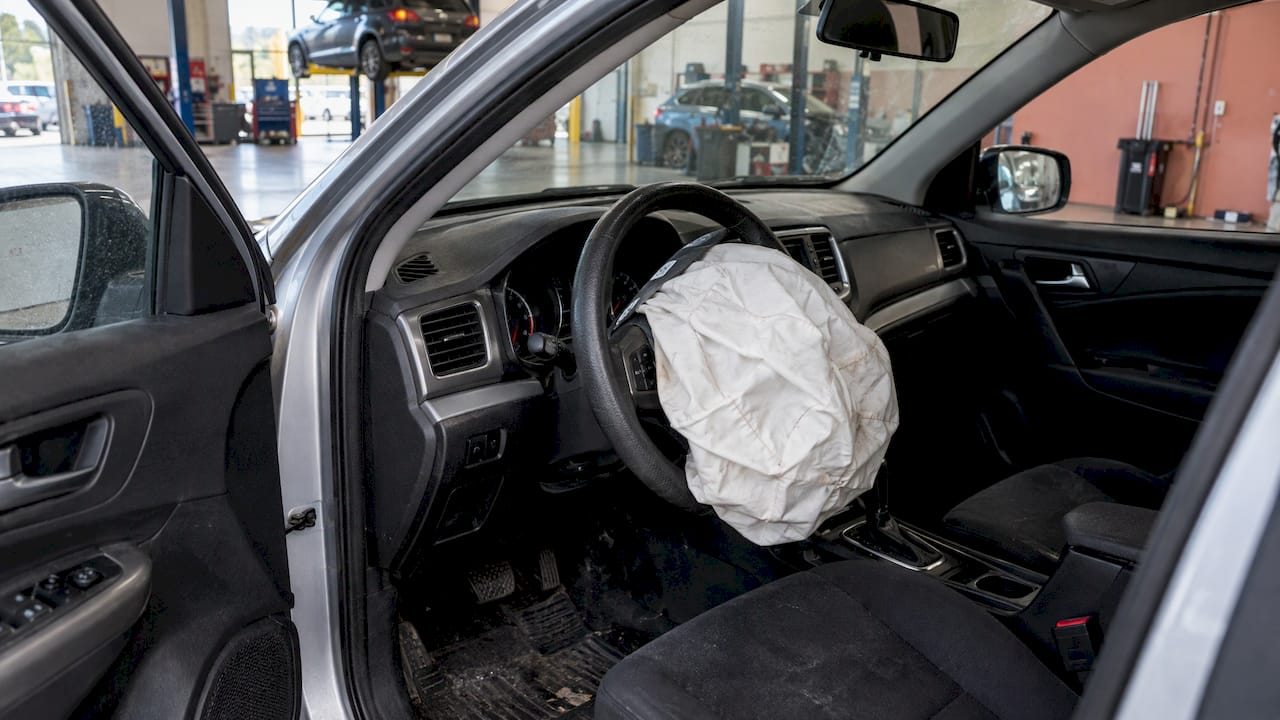
If an airbag injured you or killed someone you love, you need a lawyer who can prove what the airbag did and why, because the manufacturer’s engineers and insurers will have their own account ready. At Summit Trial Attorneys, we represent people in Las Vegas, North Las Vegas, Henderson and across Clark County and the rest of Nevada in car accident and product liability cases, and an airbag claim sits where those two meet. This guide explains how airbag injuries happen, who can be responsible, what evidence disappears fastest and what a claim can cover. No lawyer can promise a result, but the early steps you take shape what can be proven later.
Key Takeaways
- Airbags can injure even when they work as designed, and they can cause far worse harm when they are defective, counterfeit or fail to deploy.
- Responsibility can reach beyond the other driver: a manufacturer, a parts supplier, an installer or a repair shop may be involved.
- Do not repair, sell or scrap the vehicle until it has been documented and inspected. Courts have thrown out airbag cases over this.
- An airbag that did not deploy is not automatically a defect. Proving one usually takes an expert, which is why early investigation matters.
- A free case review costs nothing, and we only earn a fee if your case ends in a settlement or judgment.
Table of Contents
- How airbags injure people
- When an airbag is defective
- Can you sue when the airbag does not deploy?
- Who can be responsible
- Preserve the evidence before it disappears
- What a claim can cover
- Deadlines: act early
- Where Nevada claims arise
- Our perspective
- Talk to us about your airbag injury
- FAQ
- Sources
How airbags injure people
An airbag is built to protect you in a serious crash, and it does so by inflating with enormous speed. NHTSA, the federal vehicle safety agency, reports that airbags inflate in less than 1/20th of a second, and that serious or even fatal injury can occur when an occupant is too close to the bag or touches it as it deploys.
That speed explains the injuries we see described in airbag cases generally:
- Facial fractures, eye injuries and burns or abrasions from the bag itself
- Broken wrists, hands and arms when limbs are in the bag’s path
- Chest and neck injuries, including whiplash
- Head injuries, including concussion and traumatic brain injury (see our guide on what to know about a brain injury claim)
- Penetrating wounds when a faulty inflator sends metal fragments into the cabin
Not every airbag injury is a legal claim. The Insurance Institute for Highway Safety notes that occupants sitting or moving too close before deployment can be hurt, a bigger concern with early generations of frontal airbags. The same page reports an NHTSA estimate of more than 290 deaths from frontal airbag inflation in low-speed crashes between 1990 and 2008. Nearly 90% were in vehicles built before 1998, and more than 80% of those killed were unbelted or improperly restrained. Modern airbags are far more refined, which is why a serious injury from a newer vehicle deserves a close look at what went wrong.
When an airbag is defective
A defect is different from an airbag simply doing its violent job. Product liability law looks at whether the product was unsafe because of how it was designed, how it was made or how it was marketed and warned about. Common airbag problems fall into a few groups.
Inflators that rupture. The best-known case is Takata. NHTSA says approximately 67 million Takata airbags in priority groups 1 to 12 were recalled because they can explode on deployment and cause serious injury or death. If a recalled airbag injured you, the recall history of your exact vehicle becomes central evidence.
Counterfeit or improperly installed bags. NHTSA warns that counterfeit airbags may fail to deploy or may expel metal shrapnel during deployment. This often points to a prior repair, so the shop and the parts supplier matter.
Bags that deploy too late, too hard or when they should not. Sensor, software and design problems can cause an airbag to behave unpredictably.
Bags that fail to deploy. This is where many people get confused, and it deserves its own section.

Can you sue when the airbag does not deploy?
Sometimes, but the failure alone does not prove the case. NHTSA explains that airbags are supplemental restraints that work with seat belts and are designed for moderate-to-severe crashes, not every crash. Whether one should have fired depends on crash characteristics, the system’s design strategy and where the crash sensors are located.
That means the question in a non-deployment case is not “did it fire?” but “should it have fired in this crash, and why didn’t it?” Courts expect technical proof. In Owens v. Ford Motor Co., a federal court held that expert testimony was needed to decide whether the airbag deployed completely because jurors could not judge that on their own, and it ruled for the manufacturer when reliable expert support was missing.
The lesson for you: the strength of a non-deployment claim depends on early access to the vehicle and its data, not on how obvious the failure feels. If your airbag stayed shut in a hard frontal crash and you were seriously hurt, tell us about it. We will look at the facts and say plainly what an investigation would need to establish.

Who can be responsible
In a crash, most people think only of the other driver. An airbag claim can involve several parties at once:
| Possible party | Why it may be involved |
|---|---|
| Vehicle manufacturer | Design of the restraint system, sensors and software, or failure to act on known problems |
| Airbag or inflator maker | A part that ruptured, misfired or did not inflate |
| Repair shop or installer | Counterfeit parts, faulty installation or a disabled system after a previous repair |
| Dealer or seller | Selling a vehicle with an unrepaired recall or a known defect |
| At-fault driver | The crash that triggered the injuries in the first place |
The at-fault driver’s insurer will often be the first to call you. Separately, the product claim may be against a company with far more resources and its own defense team. Our approach comes from the other side of the table: our positioning is built on a unique perspective from former insurance defense experience, so we understand how insurers and manufacturers evaluate and contest these claims.
If a recall was involved, the recall itself can become part of the story. For a look at what vehicle owners can pursue in recall-related claims, see this overview of recall-related injury claims.
Preserve the evidence before it disappears
Airbag cases are won and lost on physical evidence. The most important rule is the simplest: do not let the vehicle be repaired, sold, crushed or auctioned until it has been documented.
That is not a theory. In Silvestri v. General Motors, a federal appeals court affirmed dismissal of an airbag product-liability suit after the car was repaired without giving the manufacturer notice or a chance to inspect it. The court treated preservation and notice as material duties. Insurers often move a totaled car to a salvage yard within days, so speed matters.
Here is a practical routine for the first weeks:
- Get medical care and keep every record. Document the airbag-related injuries specifically: burns, fractures, eye or hearing problems and head symptoms. Tell providers about the airbag.
- Do not authorize repairs or salvage. Tell your insurer in writing that the vehicle is evidence and must be held. Our case review can guide you on how to do this.
- Photograph everything. Capture the deployed or undeployed bag, the steering wheel, dashboard, seats, belts, interior debris and any torn fabric or fragments.
- Keep the parts. Do not throw away fragments, the bag module or damaged components.
- Save paperwork. Collect the police report, repair history, towing records, recall notices and the vehicle’s purchase documents.
- Check the recall status. NHTSA directs owners to check recalls by VIN, and says recall repair is free. Note the result and the date, and do not assume an older phased deadline means a repair was unnecessary. If the vehicle is evidence in an injury claim, talk to us before anyone works on it.
- Report a failure. NHTSA recommends that an airbag that fails to deploy in an injury-producing crash be reported to its Office of Defects Investigation for possible investigation and recall action.
We also help clients with evidence preservation guidance as part of the case review. For general steps at the scene and in the days after, our guide on what to do after a Las Vegas car crash walks through the basics, and our resource on Nevada semi-truck crash evidence shows how quickly vehicle data and physical evidence can vanish in serious collisions.
What a claim can cover
Compensation depends on the facts of your case and on Nevada law, and no one can honestly promise an amount. In general, injured people and families may seek recovery for:
- Past and future medical bills, including surgery, rehabilitation and long-term care
- Lost wages and reduced ability to earn a living
- Pain and suffering and loss of enjoyment of life
- Disfigurement and scarring, which are common after facial and burn injuries
What moves the value of a claim is practical: how severe and permanent the injuries are, how clearly the defect or negligence can be proven, how many responsible parties exist and what insurance or assets stand behind them. Comparative fault can also come up. If you were out of position or unbelted, expect the other side to say so, which is one more reason to build the evidence before they frame the story.
If a family member died, a wrongful death claim may be available to certain relatives and the estate. Our wrongful death team in Las Vegas handles these cases for families across Nevada.
Deadlines: act early
Every state sets time limits for injury and wrongful death lawsuits, and product claims can carry additional cutoffs measured from when the product was first sold. These rules differ widely. Florida’s statute, for example, ties product claims to discovery and caps older products at an outer limit, while Iowa applies a separate 15-year outer limit from first purchase for specified product-defect claims. Those examples show the pattern, not the Nevada rule.
In Nevada, the safest approach is to treat the clock as already running. Waiting costs you evidence, witness memory and sometimes the claim itself. A case review with us will tell you which deadlines apply to your situation.
Where Nevada claims arise
We handle cases from the Strip corridor and Downtown Las Vegas to North Las Vegas and Henderson, and across Clark County, Washoe County (Reno and Sparks), Carson City and other parts of Nevada. Airbag injuries come from freeway collisions on I-15 and US-95, rideshare crashes, and collisions involving semi-trucks and motorcycles. Ride-hail passengers in a vehicle with a defective bag may also have claims through our Uber and Lyft accident practice.
Our perspective
Airbag cases look simple from the outside: a safety device hurt someone. Inside, they are technical fights over sensors, inflators, crash data and what the vehicle “should” have done.
We believe the people who face those fights deserve straight talk and a trial-ready plan. Our work combines focused trial advocacy with direct communication, so you know what is happening in your case and why. Our team’s background in insurance defense gives us a view of how the other side builds its position, and we use it to prepare from day one.
We have handled significant product defect matters, including a $41 million settlement in a product defect case. Past results do not guarantee any future outcome, and every case turns on its own facts. What we can promise is personal attention and clarity at each stage.
If you are unsure whether what happened to you is a claim, ask us before the vehicle leaves your hands.
Travis
Talk to us about your airbag injury
Our free case review is where we look at the crash, the vehicle, your injuries and the evidence still available, then explain your options. Summit Trial Attorneys works on a contingency basis for injury cases, earning a fee from a settlement or judgment.

Start with the free case review, or see the full list of practice areas. Lawyers and firms outside Nevada can also ask about Nevada trial counsel for their clients’ cases.
FAQ
Can I sue if my airbags didn’t deploy?
Possibly. NHTSA says airbags are not intended to deploy in every crash, so the question is whether yours should have in the circumstances. Answering it usually takes expert analysis of the crash, the sensors and the vehicle’s data, which is why you should keep the car untouched.
Do I need a lawyer if the airbag injury was minor?
Minor injuries can still involve medical costs and lost time, and an insurer may treat the claim lightly. A free case review will tell you whether a claim is worth pursuing and what documentation to keep.
What if my airbag was under recall?
A recall can be important evidence, because it may show the manufacturer knew about a hazard. Keep the recall notice, note the VIN check result and do not allow repairs to the vehicle before it has been documented if you were injured.
How much does it cost to hire an airbag injury lawyer?
Our case review is free, and we handle injury cases on contingency, meaning our fee comes from a settlement or court award. We will explain the terms of any engagement before you sign.
Sources
- Vehicle Air Bags and Injury Prevention, NHTSA
- Takata Air Bag Recall Spotlight, NHTSA
- Airbags, Insurance Institute for Highway Safety
- Owens v. Ford Motor Co., 297 F. Supp. 2d 1099
- Silvestri v. General Motors Corp., 271 F.3d 583
- 2026 Florida Statutes, section 95.031
- Iowa Code 2026, section 614.1
- Recall-related injury claims
Recommended
- Las Vegas Car Accident Attorneys
- Rollover Accident Lawyer in Las Vegas and Nevada
- Las Vegas Uber & Lyft Accident Lawyers
This article was written with the assistance of AI and should never be treated as legal advice. It is not 100% guaranteed to be correct and you should never fail to contact an attorney based on its contents.
Talk with Summit
If you have questions about an injury in Nevada, our team can discuss your situation.
Request a case reviewGeneral information only; this article is not legal advice and does not create an attorney-client relationship. Past results do not guarantee future outcomes.