
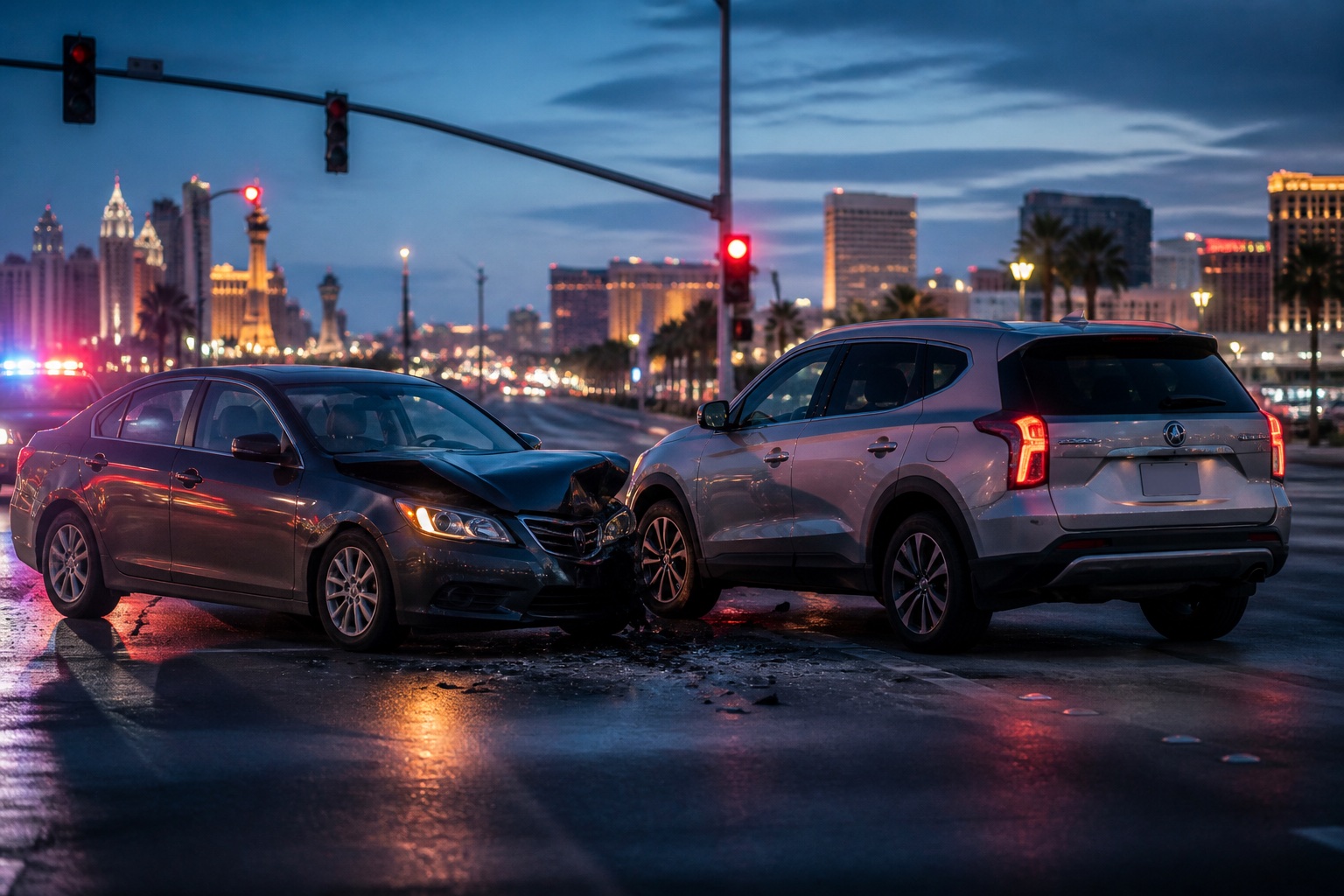
Start with safety, not the claim.
A crash on I-15, the Beltway, Las Vegas Boulevard, or a neighborhood street in Henderson does not arrive with a checklist. People are shaken. Traffic is moving. Someone is already asking who is at fault.
If you can, get yourself and anyone with you out of live lanes. Call 911 when there is injury, a disabled vehicle, or a hazard in the roadway. Follow what emergency crews tell you. The legal file can wait ten minutes. Your neck cannot.
This page is general information for people in Nevada. It is not legal advice and it does not create an attorney-client relationship. For a private review, call 702.789.4200 or write intake@stattorneys.com.
Get medical care and keep the paper.
Adrenaline hides injuries. A shoulder that felt stiff in the intersection can be a different story the next morning. Seek an appropriate evaluation. If you refuse transport at the scene, that decision often shows up later in an insurer's notes. It does not mean you were unhurt. It does mean you should get checked.
Keep discharge papers, provider names, imaging orders, prescriptions, work notes, and follow-up instructions in one place. Photograph visible bruising as it develops. Tell the clinician how the crash happened in plain language. Do not minimize pain to be polite.
If treatment continues, keep going. Gaps in care become arguments. Summit's Las Vegas car accident work starts with the medical record as it actually is, not as an adjuster summarizes it.

Photograph the scene while it still looks like the scene.
If it is safe, take more pictures than feel reasonable. Vehicles from every side. License plates. Airbags. Skid or yaw marks. Debris. Traffic signals. Wet pavement. A missing stop sign. The view each driver had. Your visible injuries. The other driver's insurance card, if you are shown one.
Wide shots and close shots
A close-up of a crumpled bumper without a street sign is hard to place. A wide shot without the point of impact is hard to explain. Take both. Include a landmark: a hotel, a mile marker, a business on the corner.
People, reports, and trip numbers
Write down every name you can: drivers, passengers, witnesses, officers, tow drivers. Ask for the incident or CAD number. If a rideshare was involved, save the trip receipt and driver details before the app archives them. If a commercial truck was involved, the record is larger than a police report. Read Nevada semi-truck crash evidence and our semi-truck crash page.
Be careful with recorded statements.
The other driver's insurer may call the same day. The voice is friendly. The request sounds routine. You can give identifying information without narrating the crash on a recorded line.
Do not guess your speed. Do not say you feel "fine" before a doctor has seen you. Do not apologize as a courtesy if you do not know what happened. Courtesy becomes a quote.
Your own carrier may have a cooperation clause. That is a different conversation from the adverse insurer's recorded statement. If you are unsure which is which, pause and call counsel. When an insurer delays, denies, or lowballs a first-party claim, the question can become one of bad faith insurance.
Nevada reporting is not the same as a lawsuit deadline.
Nevada DMV guidance says a crash that was not investigated by law enforcement and involved injury, death, or more than $750 in damage may require an SR-1 report within ten days. Confirm the current form and rule with the DMV. Filing an SR-1 is not the same as filing a civil claim.
Civil deadlines are separate. Many Nevada personal-injury actions are subject to a two-year period under NRS 11.190, but exceptions and notice rules exist. Do not treat a website as a calendar. If someone died, start with our wrongful death page and a conversation, not a forum post.
Organize the impact as it unfolds.
- Medical appointments, restrictions, and changes in treatment
- Missed work, reduced hours, and out-of-pocket costs
- Pain, sleep, driving, childcare, and the parts of a day that got harder
- Messages from insurers, body shops, and the other driver
- Whether a vehicle part, airbag, or tire failed in a way that looks like a product issue
Nevada uses a modified comparative-fault rule. An insurer may try to shift percentage points onto you. That argument is not a reason to stay silent and it is not a reason to accept the first number. It is a reason to keep a clean, dated record. Understanding your rights covers that in more detail.
What to bring to the first conversation.
You do not need a finished file. Bring photographs, the crash report if you have it, insurance cards, a medication list, and a short timeline. If Spanish is easier, say so. The office already notes Se habla español, and Nathaly Melroy can work with Spanish-speaking clients.
Summit will listen, ask a few focused questions, and tell you whether the firm may be able to help. No one can promise a result from a first call. The point is a clearer next step.
A confidential review is the shortest path from a messy scene to a plan. Past results do not predict your case.
Free case reviewQuestions people bring to the first call.
These answers are general information. They are meant to help you prepare for a conversation, not to replace advice about your situation.
Should I go to the ER if I feel okay?
Some injuries declare themselves later. If you were in a collision, get an appropriate medical evaluation and keep the paperwork. A delayed visit is not a reason to invent symptoms. It is a reason not to assume you walked away clean.
Do I have to give a recorded statement to the other driver's insurer?
You can share basic identifying and insurance information. You do not have to guess about speed, pain, or fault on a recorded line. If your own insurer asks for a statement, the policy may have a cooperation clause. Ask counsel before you sit for a recording.
What if the crash was on I-15, I-215, or the Strip?
The road does not change the first steps: safety, medical care, photographs, and a clean record. High-traffic corridors often have cameras, rideshare vehicles, and witnesses who leave quickly. Write down badge numbers, trip numbers, and nearby businesses while you still remember them.
How soon should I call a lawyer?
Sooner is usually better when evidence can move or disappear. You do not need a complete medical file before a conversation. Bring what you have. Summit can tell you whether the firm may be able to help.
Keep reading.
Other Summit guides that sit next to this one.