
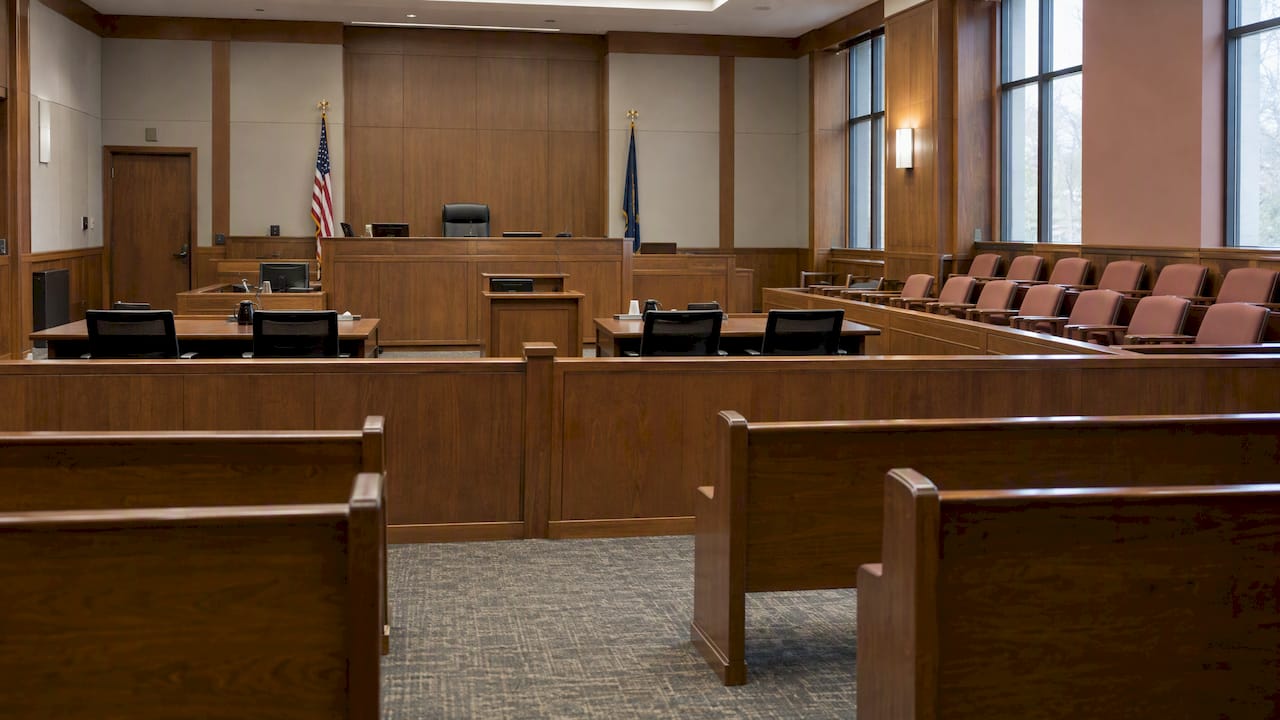
In a bench trial, a judge hears the evidence, decides the facts and applies the law. In a jury trial, the judge still rules on the law and on what evidence comes in, but a panel of citizens decides the facts and delivers the verdict. For an injured person suing in Nevada, the choice shapes how long the case takes, what it costs, who you have to persuade and how much your story matters next to the technical details.
This guide is written for civil cases, especially personal injury, wrongful death and insurance disputes. Much of what ranks for this topic is written for criminal defendants, and the strategy differs. Where Nevada law matters, we say so.
TL;DR
- Bench trial: the judge decides facts and law. It is usually faster and cheaper, and it suits technical, document-heavy disputes.
- Jury trial: citizens decide the facts. It usually fits cases built on human impact, where a plaintiff needs jurors to see what the injury took from them.
- Nevada civil juries do not have to be unanimous. Three-fourths of the jurors must agree on a verdict.
- You have to ask for a jury. A missed demand deadline can send the case to a judge by default.
- The choice is strategic, not procedural. Make it with your trial attorney after reviewing the evidence, the defendant and the judge.
Table of Contents
- What a bench trial is
- What a jury trial is
- Bench trial vs. jury trial at a glance
- Where bench trials have the edge
- Where jury trials have the edge
- How the choice works in Nevada
- Which cases tend to fit which format
- What this means if you were injured
- Our perspective
- Work with a team that prepares every case for trial
- FAQ
- Sources
What a bench trial is
A bench trial is a trial without a jury, conducted by the judge alone, who both decides the facts and applies the law. The name comes from the judge’s seat, the bench.
Otherwise, the case proceeds much as it would in front of a jury. According to FindLaw, the judge decides the facts in a bench trial, and the rest of the process looks familiar: opening statements, witnesses, exhibits, closing arguments. The difference is the audience. You are talking to one person trained in the law, who has heard many cases like yours, instead of to twelve or fewer people who have probably never sat in a courtroom.
What a jury trial is
In a jury trial, the jury makes findings of fact and renders the verdict, while the judge decides questions of law, including which evidence the jurors get to see. In a civil case, the plaintiff must prove the claim by a preponderance of the evidence, meaning it is more likely than not that the defendant is responsible for the harm.
That standard is far lower than the “beyond a reasonable doubt” standard in criminal cases. It is also why civil juries can award substantial compensation for medical costs, lost income and pain, while a criminal jury has to be nearly certain before convicting.
Bench trial vs. jury trial at a glance
| Factor | Bench trial | Jury trial |
|---|---|---|
| Who decides the facts | The judge | The jury |
| Who decides the law | The judge | The judge |
| Speed | Usually faster | Usually slower |
| Cost | Usually lower | Usually higher |
| Scheduling | Flexible, can run over days or weeks | Continuous and rigid |
| Jury selection (voir dire) | None | Required |
| Jury instructions | Not needed in the same form | Drafted, argued and read to jurors |
| Appeal to emotion | Limited effect | Often significant |
| Best for | Technical, legal or document-driven disputes | Cases where liability or damages turn on human judgment |
| Verdict | One decision-maker | Group deliberation |
Where bench trials have the edge
Speed and flexibility
Bench trials are often more efficient because they allow flexible scheduling, spread over several days or weeks to fit witness availability. A jury trial needs a tight, continuous structure so jurors are not kept away from their lives longer than necessary.
That flexibility matters when a treating surgeon or an engineer can only appear on one afternoon. The same ABA practice note explains that a bench trial lets lawyers present evidence out of sequence, such as calling an expert whenever the expert is free, without the confusion that out-of-order evidence can cause with jurors.
Less preparation
In a bench trial, lawyers can usually skip jury selection and the drafting of jury instructions, two phases that take time and money in a jury case. There is a catch: parties should expect more extensive written submissions after the trial, and these can be as labor-intensive as jury preparation. A bench trial is cheaper on average, not free.
Technical, complex cases
The ABA and other legal commentators note that bench trials are often preferred for complex, technical cases, since an experienced judge may grasp intricate evidence better than lay jurors. Think of a dispute over contract interpretation, a complicated insurance coverage question or a regulatory issue. If the case turns on a legal argument, you want the person who will rule on the law to hear it directly.
Where jury trials have the edge
Human stories and community standards
Negligence is partly a question of what a reasonable person would have done. Jurors, drawn from the community, are well placed to answer it. In a case about a hotel that ignored repeated warnings, a driver who looked at a phone, or a manufacturer that knew of a defect, the story of what happened and what it cost the injured person is central. Experienced trial attorneys often treat the waiver of a jury as a strategic decision: a case that needs an emotional appeal to establish liability usually benefits from a jury, while one with sympathetic facts but weak legal grounding may fare better before a judge.
Collective deliberation
A jury’s group discussion can act as a check. Commentators note that bench trials, while faster and cheaper, can leave litigants feeling isolated because there is no collective deliberation. One judge’s view, including how that judge’s own life experience colors the facts, is the whole verdict. The ABA practice note flags the same risk.
Settlement pressure
Insurance companies price risk. A case headed to a jury, with an unpredictable audience and a plaintiff’s attorney who is ready to try it, carries more risk for the defense than one headed to a judge. We cannot promise any outcome, but a credible jury demand changes how some insurers evaluate a claim.
How the choice works in Nevada
Nevada preserves the right to a jury. Rule 38 of the Nevada Rules of Civil Procedure states that the right of trial by jury declared by the state constitution or given by statute is preserved. It also lets a party specify which issues it wants a jury to decide. If one party demands a jury on only some issues, any other party can respond within 14 days of being served with that demand, or sooner if the court orders, by demanding a jury on the remaining factual issues.
Two practical points follow.
A jury is not automatic. You generally have to ask for one, in writing and on time. The federal rules show how strict this is: in federal court, a party must file a written demand under Fed. R. Civ. P. 38(b), and checking a box on a civil cover sheet is generally not enough. Missing the deadline typically means a bench trial. Nevada state court has its own deadlines and a jurors’ fee deposit requirement, so the person handling your case needs to calendar these at the start, not near trial.
A jury can be waived by agreement. Under the same rules, once a jury is demanded, the trial is by jury unless the parties or their attorneys file a stipulation to a nonjury trial or so stipulate on the record. That means a case can move from a jury to a judge if both sides agree, usually because a strategy has changed.

Nevada civil verdicts are not unanimous
In many people’s minds, a jury must agree on everything. In Nevada civil cases, it does not. Under the Nevada Constitution, three-fourths of the jurors must agree for the verdict to stand, according to the state’s 2018 civil jury instructions. For a plaintiff, that means one or two holdouts cannot block a verdict. For a defendant, it means the same.
Nevada also runs a separate track in Justice Court, where jury trial rules were developed to limit the length of trial. Smaller disputes in Justice Court can follow different procedures from a District Court injury lawsuit, so confirm which court your claim belongs in.
Which cases tend to fit which format
No rule decides this. These are the questions we weigh on real cases, and the patterns below come from our trial practice, not from a statute.
| Situation | Why a jury often helps | Why a judge might be better |
|---|---|---|
| Serious injury with a clear, sympathetic story | Jurors can weigh pain, loss and life changes | The judge may apply damages more conservatively |
| Wrongful death | Jurors hear what a family lost | Rarely the better choice |
| Insurer refused a fair claim | Jurors can judge conduct in a way that feels familiar | A technical coverage question may be a pure legal issue |
| Product defect | Jurors can respond to a company that put profit over safety | Complex engineering may suit a judge, but the stakes often call for a jury |
| Narrow legal question, few disputed facts | Little for jurors to add | Judge reads the law directly, faster and cheaper |
| Weak liability facts, strong sympathy | A jury may be moved but the law must still be met | A judge may be more rigorous, which can cut both ways |
What matters is the specific claim, the defendant, the available evidence and the judge assigned. A hotel or casino with a polished corporate defense invites a different approach from a single driver with minimal insurance.
What this means if you were injured
- Do not assume a trial is coming. Most cases never get there. Federal judges encourage litigants to settle and courts promote mediation and arbitration. Even so, a case built for trial gets better settlement offers than one built to settle.
- Preserve evidence early. Photos, video, medical records, incident reports and witness names matter to both a judge and a jury.
- Talk to an attorney before any jury deadline passes. Waiving a jury by silence is easy to do and hard to undo.
- Ask how your attorney thinks about trial. A lawyer who never tries cases will tend to treat the jury question as an afterthought.
Our perspective
We are a trial firm, and the reason is how insurance companies behave. Our approach comes from understanding the defense side of insurance disputes: how adjusters value a claim, how defense lawyers prepare, and what makes them take a case seriously. That background shapes how we think about jury versus bench trials.
For most serious injury and wrongful death cases, we want a jury. The people who sit on it live in the same community as the person who was hurt. They know what a hotel owes guests, what a driver owes everyone else on Las Vegas roads and what a company owes the people who use its products. That is a natural audience for a plaintiff with a legitimate claim.
But we never treat the jury as the default. Where a case turns on a narrow legal point, or on technical evidence that a judge can absorb more efficiently, we say so. The decision depends on the evidence, not on habit. We also tell clients plainly about the tradeoffs, including cost and time, because the person paying the price of a long case is the injured person, not us.
Direct communication is how we work. You should know what is coming, why we recommend it and what the alternatives are, and you should hear it from the attorneys handling your case.
Work with a team that prepares every case for trial
We represent injured people and families in Nevada on a contingency basis, meaning our fees come from a settlement or judgment. Our work includes car accidents, wrongful death, hotel injuries, product liability and insurance bad faith, among other practice areas. Notable results include a $41 million product defect case.
If you are weighing a claim and wondering how a trial might play out, request a free case review. We will look at what happened, what evidence exists and what a court process would involve.
Other lawyers sometimes need Nevada trial counsel for a case filed here. We work with referring and out-of-state firms as well.
FAQ
Why would someone prefer a bench trial?
People choose a bench trial for speed, lower cost and flexible scheduling. It also suits cases that depend on technical evidence or a pure legal argument, where a judge’s experience is an advantage. It is less attractive when the case depends on sympathy or community standards.
Can I choose between a bench trial and a jury trial in Nevada?
Often yes, but you have to act. Nevada preserves the right to a jury in civil cases, and a party must make a timely written demand under the Nevada Rules of Civil Procedure. If no one demands one, or if the parties stipulate to a nonjury trial, a judge decides the case. Your attorney should track the deadline from the start.
Does a jury have to be unanimous in a Nevada civil case?
No. In a typical Nevada civil case, three-fourths of the jurors must agree on the verdict. Criminal cases follow different rules, so do not assume the civil standard applies there.
Is a jury trial better for the injured person?
In many serious injury cases a jury is the stronger forum, because jurors can weigh the human cost of an injury. It is not universal. A case with a narrow legal issue or complex technical evidence may be better before a judge, and the decision should come from the facts of your case.
Does my case have to go to trial at all?
No. Most civil cases resolve before trial through settlement, and courts encourage mediation and arbitration. Still, being ready for either a bench trial or a jury trial affects what the other side is willing to offer.
Sources
- Bench Trials (Federal), American Bar Association
- American Bar Association
- Judge vs. Jury Trials, FindLaw
- Bench trial, Legal Information Institute (Cornell)
- Jury trial, Legal Information Institute (Cornell)
- Civil Cases, U.S. Courts
- Nevada Rules of Civil Procedure
- Nevada Civil Jury Instructions (2018)
- Northern District of California Civil Local Rules
- Justice Court Rules of Civil Procedure, Clark County
Recommended
This article was written with the assistance of AI and should never be treated as legal advice. It is not 100% guaranteed to be correct and you should never fail to contact an attorney based on its contents.
Talk with Summit
If you have questions about an injury in Nevada, our team can discuss your situation.
Request a case reviewGeneral information only; this article is not legal advice and does not create an attorney-client relationship. Past results do not guarantee future outcomes.