A head-on collision lawyer takes over the fight with the insurance companies, proves which driver caused the crash and builds the full value of your injuries or your loss. If you were hurt, or you lost a family member, in a head-on crash in Las Vegas or anywhere else in Nevada, the sooner a lawyer starts preserving evidence, the stronger your claim tends to be. At Summit Trial Attorneys, our team includes lawyers with insurance defense experience, and we use that knowledge to anticipate how the other side will try to reduce or deny your claim. You can start with a free case review and talk directly with a lawyer about what happened.
Key Takeaways
- Head-on crashes often cause catastrophic injuries and deaths, so claims are usually large and the insurer’s defense is usually aggressive.
- The central question is fault: who crossed the center line, and why. Evidence disappears fast, so early action matters.
- More than one party can be responsible: another driver, an employer, a vehicle or parts maker, a bar or a road owner.
- Personal injury lawyers commonly work on contingency, meaning fees come from a settlement or judgment, not from your pocket upfront.
- Nevada sets filing deadlines. Missing one can end a claim, whatever its strength. No lawyer can promise a result, but a prepared case gives you the best position.
Table of Contents
- What a head-on collision lawyer actually does
- When you should call a lawyer
- What causes head-on crashes, and why it matters for your claim
- The evidence that proves who was at fault
- Who can be held liable
- What you can recover
- How shared fault can affect your claim
- What to do after a head-on crash
- How insurers handle these claims, including bad faith
- Deadlines you cannot miss
- How fees and costs work
- Perspective: why we prepare every case as if it will be tried
- Talk to a Nevada trial firm about your head-on crash
- FAQ
- Sources
What a head-on collision lawyer actually does
A head-on crash happens when the fronts of two vehicles hit each other, usually because one vehicle drifts or drives into the oncoming lane. The combined force of both vehicles is why these cases so often involve brain injuries, spinal cord damage, broken bones, internal bleeding and death.
A lawyer handling this kind of case does several jobs at once:
- Investigates the crash. That means securing the police report, photographs, witness names and the vehicles themselves before they are repaired or scrapped.
- Identifies every responsible party. The driver you can see is not always the only one.
- Values the claim. Medical bills to date are only the start. A serious case includes future care, lost earning capacity and the impact on daily life.
- Deals with the insurers. You stop giving recorded statements and stop fielding calls from adjusters.
- Files and tries the lawsuit if the insurer will not pay fairly. Some cases settle; others need a courtroom.
That last point is where firms differ. Insurers track which law firms prepare cases for trial and which do not, and they value the claims accordingly. We are a trial firm: our approach combines focused trial advocacy with direct communication, so you know where your case stands.
When you should call a lawyer
Call as soon as you are medically stable, and before you talk to the at-fault driver’s insurer. Situations where help is most urgent include:
- You were taken to a hospital, had surgery or face long-term treatment.
- A family member died. Our guide to who can file a wrongful death lawsuit, deadlines and damages explains who may bring the claim.
- The other driver was drunk, distracted, fleeing police or driving for work.
- The other driver left the scene. See our page on what a hit and run lawyer does.
- An insurer has offered a quick payment or asked you to sign a release.
- You had a head injury, even if you felt fine at first. Our article on brain injury claims covers what to know.
There is no cost to ask. Summit offers a free case review, and a conversation tells you where you stand.
What causes head-on crashes, and why it matters for your claim
Fault is the center of a head-on case, and the cause shapes who can be held responsible. Common causes include:
- Distracted driving. Phone use or other distractions that let a car drift across the center line.
- Impaired driving. Alcohol, cannabis, prescription drugs or other substances. Wrong-way driving on highways such as I-15 or US-95 is often tied to impairment. Criminal charges can run alongside your civil claim, and the article on how serious injury affects DUI bail in Nevada shows how the criminal side can unfold for a driver.
- Drowsy driving. Fatigue, especially on long rural stretches between Las Vegas, Pahrump, Mesquite and Reno.
- Passing mistakes. Misjudging oncoming traffic on two-lane roads.
- Speeding or losing control on curves, wet roads or in winter conditions in northern Nevada, such as in Washoe County.
- Vehicle defects. A steering failure, tire blowout or brake problem can send a car across the line. That points to a product claim against a manufacturer. See our product liability practice.
- Road design or maintenance. Missing signage, poor lane markings or hazards that were never addressed.
It is also common for the driver at fault to say you were the one who crossed over. That is why physical evidence matters so much.
The evidence that proves who was at fault
In a head-on collision, each driver may tell a different story, and the most serious injuries can leave you unable to describe what happened. A lawyer builds the case from sources that do not depend on memory:
- The police report and responding officer’s notes. Includes diagrams, citations and statements at the scene.
- Vehicle data. Many modern vehicles record speed, braking and steering inputs. This data can be overwritten or lost if the car is repaired, sold or salvaged.
- Scene evidence. Gouge marks, debris fields, skid marks and the point of impact show which lane each vehicle was in. These fade within days.
- Video. Traffic cameras, dashcams and nearby business cameras often keep footage for a short period only. Along the Las Vegas Strip, Fremont Street and busy corridors like Boulder Highway, cameras are plentiful but retention windows are short.
- Phone records and driver history. Used to test claims about distraction or impairment.
- Medical records and toxicology. They document the injuries and, in some cases, the other driver’s condition.
- Reconstruction and medical experts. An accident reconstructionist can work out vehicle paths and speeds, and physicians can explain how the injuries connect to the crash.
A letter sent early asking the other party to preserve evidence puts them on notice not to destroy it. This is part of the evidence preservation guidance we give clients. If you are able, take photos of the scene and your injuries, and keep the damaged vehicle where it is until your lawyer has had it examined.
Who can be held liable
The driver who crossed the center line is the obvious defendant. In serious cases there may be others:
| Possible responsible party | Why they may be liable |
|---|---|
| The other driver | Negligence: distraction, impairment, speeding, unsafe passing |
| An employer | If the driver was on the job, the company may be responsible for the driver’s actions |
| A rideshare company or driver | Crashes involving app-based drivers raise separate insurance questions. See our Uber and Lyft accident page |
| A trucking company | Fatigue, poor maintenance or inadequate training. See our semi-truck crash attorneys |
| A manufacturer or parts maker | A defect in steering, tires, brakes or other components |
| A bar, club or host | Serving a visibly intoxicated person who then drove, in situations Nevada law recognizes |
| A government or road owner | Dangerous road conditions the owner knew or should have known about |
If you were riding a motorcycle, the same analysis applies, and injuries are often even more severe. See our Las Vegas motorcycle accident lawyers. If you were a pedestrian, read about what a pedestrian accident lawyer does.
What you can recover
Damages in a head-on case generally fall into two groups. Economic damages are the costs you can add up: emergency care, surgeries, rehabilitation, future medical needs, lost wages and lost earning capacity, and property damage. Non-economic damages cover pain, suffering and the loss of the life you had.
When someone dies, the family’s claim looks different. As one example of how courts describe it, Michigan’s courts treat wrongful death damages as fair and equitable under all the circumstances. They can include medical, funeral and burial expenses, the person’s conscious pain and suffering, and the loss of financial support and of society and companionship. Each state sets its own rules, and in Nevada, who may file and what is recoverable is explained on our wrongful death attorneys page.
What moves the number most:
- How severe and permanent the injuries are, and how well they are documented.
- How clearly fault can be shown.
- The insurance available. Policies sometimes fall short of the real losses, which is where additional defendants or your own coverage come in.
- Your own share of fault, if the other side argues you contributed.
No honest lawyer can promise a particular result. What a lawyer can do is document the full scope of your losses so that any offer is measured against the real figure.
How shared fault can affect your claim
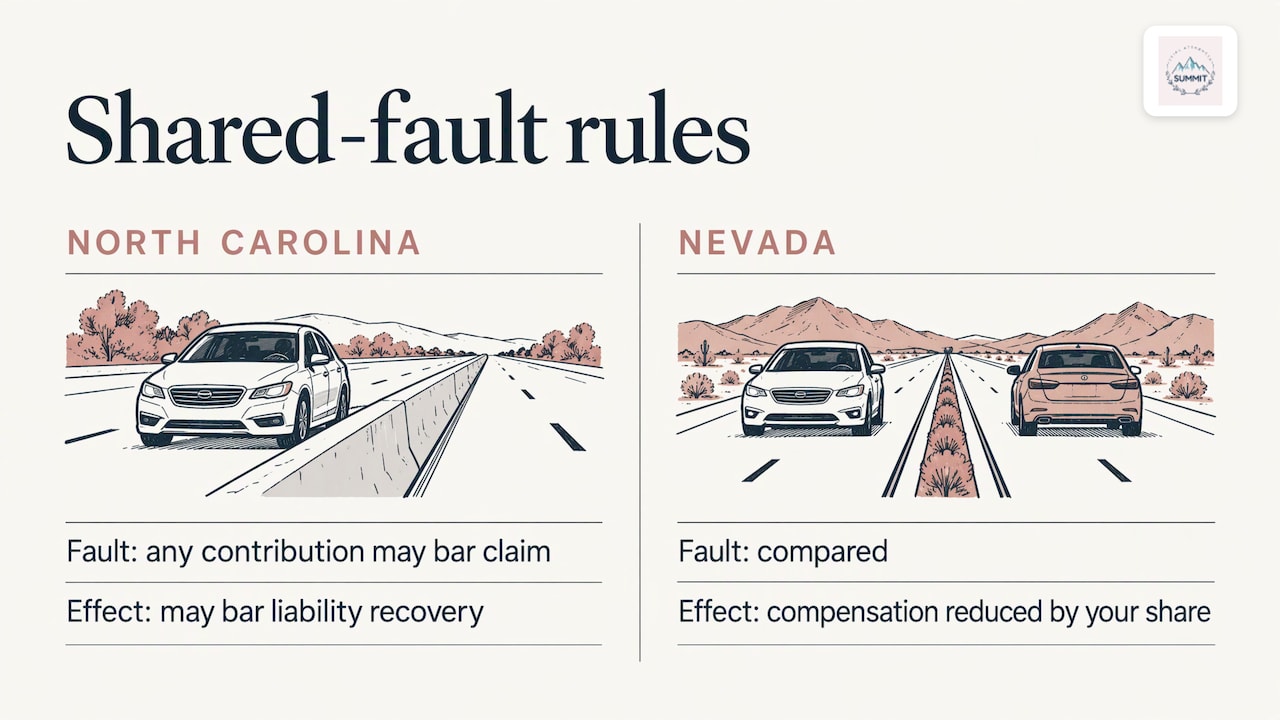
States treat shared fault differently. In North Carolina, for example, the state insurance department explains that a driver who contributed in any way to an accident may be barred from collecting on a liability claim. Nevada follows a different system in which fault is compared and compensation can be reduced by your share. Because insurers lean on this argument, even in head-on crashes where one lane crossing seems obvious, your own words matter. Do not guess about speed, lane position or what you could have done differently when speaking to an adjuster.
What to do after a head-on crash
- Get medical care immediately. Some serious injuries, including brain and internal injuries, are not obvious right away. Follow the treatment plan.
- Call 911 and wait for police. Make sure a report is made, whether the crash is in Las Vegas, Henderson, North Las Vegas or an unincorporated area of Clark County.
- Document what you can. Photos of both vehicles, the lane, debris and your injuries. Names of witnesses.
- Keep the vehicle and your records. Do not authorize repairs or salvage before the evidence has been examined.
- Be careful with insurers. Report the crash to your own insurer as your policy requires, but do not give a recorded statement to the other side or sign a release or medical authorization without legal advice.
- Call a lawyer. Our guide on what to do after a Las Vegas car crash goes through the early steps in more detail.
Nevada has insurance minimums that every registered driver must meet, as the Nevada Division of Insurance explains for consumers. In a head-on crash with serious injuries, medical bills can exceed those minimums quickly, which is one reason the search for additional coverage and responsible parties starts early.
How insurers handle these claims, including bad faith
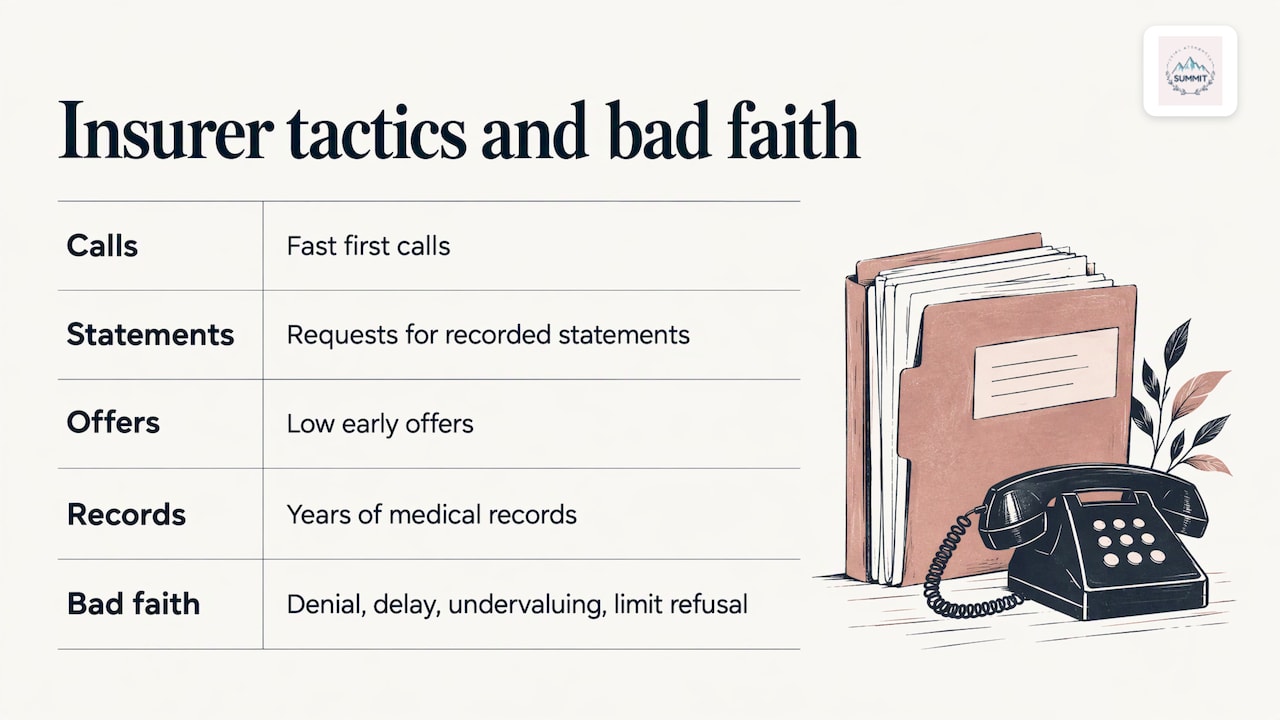
Insurers are businesses. Even in a clear-fault crash, the adjuster’s task is to resolve the claim for as little as possible. Expect fast first calls, requests for recorded statements, low early offers and requests for years of medical records.
Sometimes an insurer goes beyond hard bargaining. If a company unreasonably denies, delays or undervalues a valid claim, or refuses to settle within policy limits when it should, that can be insurance bad faith, which is a separate legal claim. It can matter in head-on cases because the policy limits are often what stands between a family and the care they need. Summit handles bad faith insurance cases as one of its practice areas.
Deadlines you cannot miss
Every personal injury and wrongful death claim in Nevada has a filing deadline, and the time limits differ by the type of claim and the defendant. Claims against government entities and certain defendants can have shorter or special notice requirements. Read our overview of Nevada’s personal injury statute of limitations and the difference between limitations and repose deadlines. Because the deadline can start on different dates depending on the facts, do not wait to find out which applies to you.
How fees and costs work
Summit represents injury clients on a contingency basis: our fee comes from a settlement or court award in your case. You are not billed hourly while the case is pending. Case costs, such as records, experts and filing fees, and how they are handled are explained in the fee agreement before you sign, and we walk you through it in your free case review. Ask any lawyer you consider to show you in writing how fees and costs are calculated.
Perspective: why we prepare every case as if it will be tried
We practice at a time when insurers hold the advantage in most disputes. Many of us at Summit know that from the inside, because we have seen how the defense side of an insurance dispute evaluates a claim, what it looks for and what it discounts.
In a head-on collision case, that experience shapes how we work from the first day. We secure the physical and electronic evidence before it is gone. We build the case around how a jury would see it, not just what a claims adjuster will pay. And we talk to our clients directly, so a family dealing with a serious injury or a death is never left guessing where things stand.
Our results include a $41 million product defect case, among other significant outcomes. We make no promises about any future case, because every one depends on its facts. But a case prepared for trial is the one an insurer takes most seriously.
Travis
Talk to a Nevada trial firm about your head-on crash
Summit Trial Attorneys represents individuals and families across Nevada, from Las Vegas, North Las Vegas and Henderson to Reno and the rural counties. Our car accident practice covers head-on collisions, and our team handles wrongful death and bad faith insurance claims as well. A free case review gives you a clear view of your options without obligation.

Start your free case review today, or see all practice areas.
FAQ
Do I need a lawyer if the other driver was clearly at fault?
Clear fault does not mean a fair payment. The insurer can still dispute the extent of your injuries, argue that you shared blame, or offer an amount that does not cover long-term needs. A lawyer measures your full losses and handles the negotiation.
How much does a head-on collision lawyer cost?
At Summit, injury representation is on a contingency basis, so our fee is taken from a settlement or award rather than billed up front. We explain how fees and case costs work in the free case review, before you commit to anything.
What if the other driver died in the crash?
You may still have a claim, typically against the at-fault driver’s insurance coverage and, depending on the facts, against others such as an employer or vehicle manufacturer. A lawyer can identify the available policies and the right defendants.
Can a family file a claim if a loved one died in a head-on collision?
Yes. Nevada law limits who can bring a wrongful death claim and sets deadlines. Our guide on wrongful death lawsuits explains who may file and what damages may be sought, and we can review your situation directly.
How long do I have to file?
Nevada sets deadlines that vary by claim type and defendant, and some start on different dates. The safest approach is to speak with a lawyer promptly so the right deadline is identified and met.
Sources
- Michigan Courts: Wrongful Death Act benchbook
- North Carolina Department of Insurance: After an Accident
- Nevada Division of Insurance: Automobile Insurance
- How serious injury changes bail standing for a DUI in Nevada
Recommended
- Hit and Run Lawyer: What One Does and When to Call
- What to do after a Las Vegas car crash
- Talking to Insurers After a Crash
- Drunk Driving Accident Lawyer in Las Vegas and Nevada
This article was written with the assistance of AI and should never be treated as legal advice. It is not 100% guaranteed to be correct and you should never fail to contact an attorney based on its contents.
Talk with Summit
If you have questions about an injury in Nevada, our team can discuss your situation.
Request a case reviewGeneral information only; this article is not legal advice and does not create an attorney-client relationship. Past results do not guarantee future outcomes.