
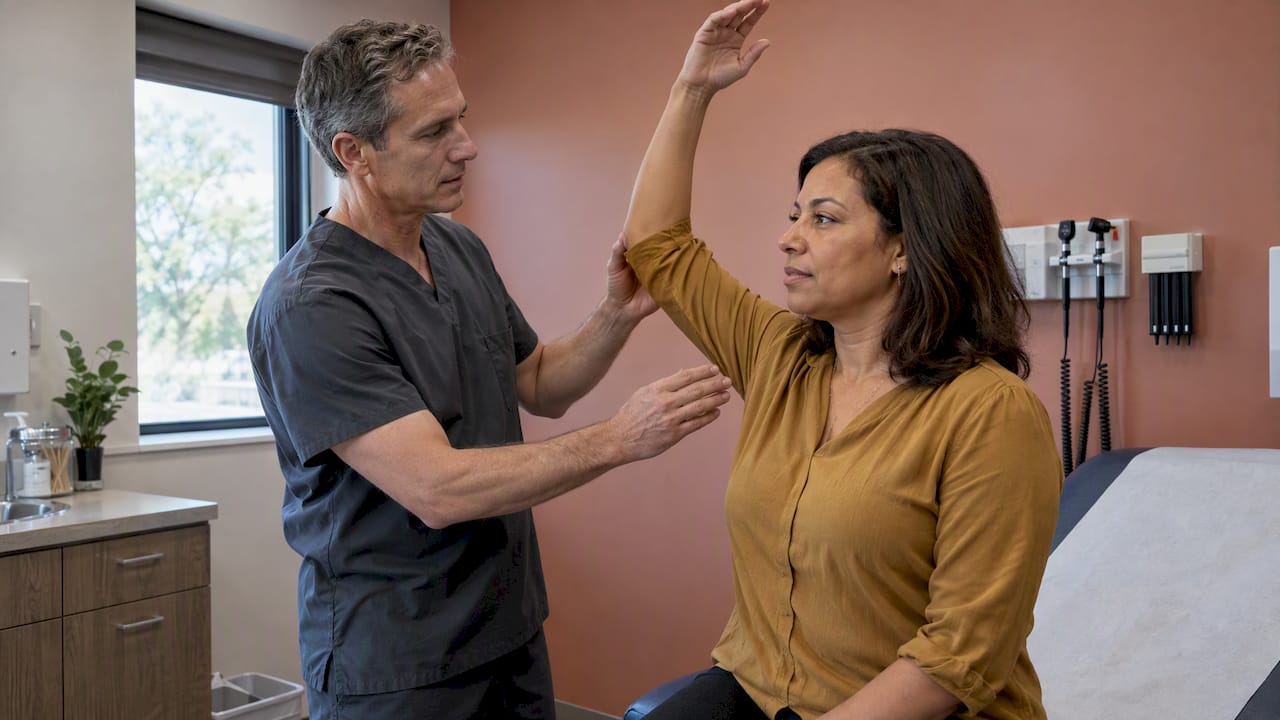
An independent medical exam (IME) is a one-time evaluation by a doctor who has never treated you. Someone else asked for it and is paying for it: usually an insurance company, an employer or a defense lawyer. The examiner’s job is to answer questions for that party about your diagnosis, what caused your injury, how impaired you are and what treatment you will need. The word “independent” means the doctor is not your doctor. It does not mean the doctor works for nobody.
If you have a notice in hand, the rest of this guide covers what the exam is, how it differs from your own doctor’s care, what Nevada rules say about observers and recordings, and what to do before, during and after.
TL;DR
- An IME is a records review and exam by a doctor chosen and paid for by the party that requested it. It is not treatment, and the report is written for them.
- Insurers use IME reports to dispute causation, cut off treatment or lower what a claim is worth. A bad report can hurt, but a poor one can be challenged.
- In a Nevada lawsuit, Rule 35 controls the exam. You may ask to bring one observer, with limits, and the court may order an audio recording for good cause.
- Be accurate, consistent and polite. Do not exaggerate, do not downplay, and do not guess at things you do not know.
- Call a lawyer before you attend, especially if you are unsure whether you are required to go. Missing an exam you were required to attend can cost you benefits or money.
Table of Contents
- What an independent medical exam actually is
- IME doctor vs. your treating doctor
- Why you got the notice
- Your rights in Nevada
- Who pays for an IME
- How to prepare
- What happens after the exam
- Our perspective
- When to get a lawyer involved
- FAQ
- Sources
What an independent medical exam actually is
An IME is a one-time assessment by a provider with no prior treatment relationship with the patient. The party that requests it wants an opinion on causation, diagnosis, impairment and future care. You will see these exams in workers’ compensation, disability and personal injury claims.
The name changes by setting. You may see “independent medical evaluation,” “Rule 35 exam,” “defense medical exam” or “compulsory medical exam.” They are the same basic event: a doctor you did not choose examines you so someone else can use the findings.
Three features shape everything that follows:
- It is one visit. The examiner sees you once, often for a short time, and reads your records.
- It produces a report, not care. Experts caution that an IME is not a therapeutic encounter. The goal is to gather data for the questions the hiring party asked.
- The report has consequences. It can become the basis for denying a claim, ending treatment payments or arguing that your injuries were already there.
IME doctor vs. your treating doctor
This is the question most people have, and it is a fair one. Your treating physician and an IME physician play different roles. According to the American Medical Association’s guidance, the treating physician acts as the patient’s advocate, while the IME physician gives an assessment for a third party.
| Your treating doctor | IME doctor | |
|---|---|---|
| Who chose them | You (or your referral) | The party requesting the exam |
| Who pays | You, your health plan or a lien arrangement | The requesting party |
| Goal | Diagnose and treat | Answer the hiring party’s questions |
| Relationship | Ongoing | One visit |
| Who gets the report | You and your care team | The party that ordered it |
| What they know about you | Months of symptoms and progress | Your records and a short exam |
Neither role is dishonest. But the difference explains why an IME doctor can read the same MRI as your surgeon and reach a different conclusion. The treating doctor watched your recovery. The IME doctor was asked, in effect, to look at one snapshot and say whether the claim holds up.
There is one more wrinkle. An IME does not create a full doctor-patient relationship, but it creates a limited one. The examiner must not harm you and should disclose major, previously unknown findings. The examiner is still not your physician, and what you say and do in the room can be used to challenge your claim.
Why you got the notice
There are two main settings in which an IME comes up in Nevada, and they work differently.

Workers’ compensation. An insurer can schedule an exam with a doctor other than your treating physician. Notice rules vary by state. As one example, Oregon’s workers’ compensation agency says insurers generally give written notice at least 10 days ahead, listing the date, time, place, provider and purpose, and that missing the exam can lead to suspended or denied benefits. Check your own state’s rules and the notice you received.
Personal injury lawsuits. Once you sue over a car crash, a fall in a hotel or casino, or a product injury, you put your physical or mental condition at issue. The defense can ask a court for an exam under Nevada Rule of Civil Procedure 35, discussed below. Before a lawsuit, whether you must attend anything depends on your policy language and the facts, so ask a lawyer before you agree to anything. Do not assume a letter from an insurer is an order.
Insurers are not subtle about why they ask. A report that says your injury was minor, old or unrelated gives them a reason to deny or reduce. The Wisconsin Department of Workforce Development explains that an IME opinion does not technically close a claim, but if it concludes no work-related injury occurred, it can serve as the legal basis for denying further benefits. Treat the exam as a high-stakes event, not a formality.
Your rights in Nevada
Nevada has had a back-and-forth on this, and much online advice is out of date.
For a few years, a state statute, NRS 52.380, gave people the right to have an observer and an audio recording at a defense exam without first showing good cause. In late 2021 the Nevada Supreme Court found that statute unconstitutional on separation-of-powers grounds. As a defense-side law firm’s summary of the ruling puts it, procedures for these exams are found exclusively in Rule 35.
The text of NRCP 35 as published in the legislative record says the following (confirm the current version with your attorney, since rules can be amended):
- The exam needs a court order or agreement. The order must be sought on motion, for good cause, on notice to you. It must specify the time, place, manner, conditions and scope, and who will perform it. The exam must take place in a professional setting in the judicial district where the case is pending, unless the parties agree or the court orders otherwise.
- Observer. You may request one observer as a condition of the exam. You must identify the person and their relationship to you. The observer cannot be your attorney or anyone employed by you or your attorney, and must not interfere, obstruct or participate. For neuropsychological, psychological or psychiatric exams, no observer is allowed unless the court orders otherwise for good cause.
- Audio recording. On request of a party or the examiner, the court may require a recording for good cause. Whoever asks arranges and pays for it and must provide a copy on written request. Everyone present must be told before the exam starts.
So you do not have an automatic right to a recording in Nevada the way you once did. You have a right to ask, and your lawyer can raise it with the discovery commissioner before the exam, not at the front desk of the clinic.
Other rights are practical rather than technical. You have the right to receive the details of the exam in writing, to have a lawyer review the conditions, to object to scope, and to decline to sign a form that goes beyond what the order allows. Examinees may be asked to sign a waiver acknowledging the forensic purpose of the exam and that medical history will be discussed. Hand any form to your attorney before you sign it.
Who pays for an IME
Not you. The costs fall on the entity requesting the exam, such as the insurer or the defense firm. In workers’ compensation, Nevada’s Division of Industrial Relations publishes a fee schedule. The 2024 version lists code NV02001 with a base reimbursement of $1,969.26 for a standard record review, testing and report covering up to two body parts. Forensic physicians in other settings often bill by the hour, and the research we reviewed puts typical rates at roughly $275 to $600 an hour for review and evaluation time.
The cost matters for one reason. A doctor who is paid several thousand dollars per exam by the same insurers over and over has a financial relationship with them. That does not make every IME doctor biased, but it is fair to ask in a deposition how many exams they do, how often they work for the defense side and what share of their income that represents.
The same fee schedule shows what a no-show can cost you. In Nevada workers’ compensation, a missed or very late appointment can produce a fee of $738.46 under the 2024 schedule. If you cannot make the date, tell your lawyer immediately and get any rescheduling in writing.
How to prepare
You cannot control the examiner. You can control what the examiner sees and hears from you.
Before the day
- Send the notice to your lawyer the day it arrives. Dates, scope and conditions can often be negotiated, but not after the fact.
- Confirm the details in writing. Date, time, address, the doctor’s name, the type of exam, and whether an observer or recording has been approved.
- Know your own records. Reread your intake forms, therapy notes and imaging reports. The examiner will have them, and you should know what they say about your symptoms, onset and prior problems.
- Write a one-page timeline. Accident date, first symptoms, treatment, work restrictions, past injuries to the same body parts. Keep it for your own reference.
- Gather proof of how the injury affects daily life. If you are also building a disability or benefits case, organized paperwork helps. This guide to documents that prove a disability covers how to assemble medical and work records into a clear file.
- Plan the logistics. Arrive early, bring photo ID, your medication list and glasses if you use them. If pain makes travel hard, tell your lawyer ahead of time.
In the room
This is the answer to the question people search most: what not to say to an IME doctor. There is no magic phrase. The rule is to be accurate, no more and no less.
- Do not exaggerate. Overstating pain is easy to spot, because examiners test the same movement several ways and watch you before and after the formal exam. One inconsistency can undermine your credibility on everything else.
- Do not minimize either. People who are polite or stoic often say “I’m fine” or “it’s not that bad.” That line will end up in the report. If you have good days and bad days, say so and describe a bad day.
- Describe, do not diagnose. Say where it hurts, when and what it stops you from doing. Skip theories about what caused it.
- Do not guess. “I don’t remember” is better than a wrong date.
- Do not discuss fault or the lawsuit. Questions about the crash itself are usually limited to how your body moved and where it hurt.
- Assume you are observed from the parking lot on. Examiners and staff may note how you walk, sit, carry things and get in and out of the car.
- Stop if something hurts. Say so plainly. Do not push through a test and then report that it was painful.
- Keep your own notes afterward. As soon as you leave, write down how long you were with the examiner, which tests were done, what was asked and whether anything seemed off.
And remember it is not a treatment visit. Do not expect advice, reassurance or an updated care plan.
What happens after the exam
The examiner writes a report for the party that hired them. In a lawsuit it is exchanged under the discovery rules. Your lawyer will compare it against your treating physicians’ records, the imaging, and what actually happened in the exam room.
A negative report is not the end. Common ways lawyers respond:
- Compare the report to the notes and objective findings in the records. Reports often rest on a short exam and a selective reading of the file.
- Point out what the examiner did not review, did not test or did not account for, such as prior baselines, imaging or treating surgeon opinions.
- Depose the examiner about how many exams they perform for the defense and how they reached their conclusions.
- Ask your treating doctors to address the examiner’s specific conclusions in writing or in testimony.
- In a workers’ compensation matter, use the dispute process for challenging the decision.
If the IME report is used to deny or cut off benefits that your own insurer owes you, that can raise a separate issue. Insurers owe duties of good faith to their policyholders, and relying on a one-sided report to avoid paying a valid claim may be bad faith insurance conduct worth evaluating with a lawyer.
Our perspective
We have sat on both sides of this process. Our approach to injury cases comes from understanding how insurance defense teams build a file, and the IME is one of their most reliable tools. It is cheap relative to the value of a serious claim, and it produces a document that sounds neutral.
Here is what that experience has taught us about how people lose ground at an IME:
- They go in not knowing the exam can be shaped. Time, scope, conditions and observers are often negotiable or governed by a rule, and that conversation has to happen before the exam.
- They treat it like a doctor’s visit and speak casually. A one-line comment in an examiner’s chart can be quoted back for years.
- They wait to call a lawyer until the report is in. By then the only option is to rebut it.
We talk to every client about this early, directly, and without a script. We also keep the exam in context: it is one piece of evidence, and it competes with the records of the doctors who actually treated you. When a serious injury case goes to trial, a well-prepared plaintiff and a cross-examined examiner look very different from what the insurer’s file implied.
When to get a lawyer involved
Call before you attend if any of the following is true:
- You received a notice from an insurer and are not sure it is a legal requirement.
- You are in a lawsuit and the defense has moved for an exam under Rule 35.
- The exam is psychological, neuropsychological or psychiatric, where observers are restricted.
- Your injuries are serious, permanent or tied to a large claim, such as a car accident, a casino or hotel injury, or a wrongful death case where the exam concerns a surviving family member.
- Your insurer is relying on a prior IME to stop paying.
If you were hurt in Las Vegas or elsewhere in Nevada and an IME is on your calendar, we can review the notice, explain what the other side can and cannot require, and prepare you for the appointment. Start with a free case review. We work on contingency for injury cases, so you are not paying hourly to ask the question.
FAQ
What is an IME in a personal injury case?
It is an exam by a doctor who did not treat you, requested by the defense or an insurer. In a Nevada lawsuit it is governed by Rule 35 and usually requires an agreement or a court order. The doctor’s report is written for the party that hired them.
Can I refuse an independent medical exam?
Sometimes, but not safely on your own. In workers’ compensation, skipping a required exam can lead to suspended or denied benefits. In a lawsuit, refusing a court-ordered exam can bring sanctions. If you think the request is improper, let your lawyer object or negotiate conditions before the date.
Can I bring someone with me to an IME in Nevada?
Under Rule 35 you may ask to have one observer present, identified in advance, who cannot be your attorney or anyone working for you or your attorney. The observer cannot interfere. No observer is allowed for psychological, neuropsychological or psychiatric exams unless the court orders otherwise for good cause.
How long does an IME take, and do I get a copy of the report?
Length depends on the exam type, and many are far shorter than a regular specialist visit. In a lawsuit, the report is exchanged through the discovery process, so your lawyer will receive it. In other settings, ask for it in writing and ask your lawyer to request it.
Sources
- Independent medical examination, Wikipedia
- Oregon DCBS, Independent medical examinations FAQ
- AMA Guides Newsletter on treating vs. IME physicians
- Wisconsin DWD, IME training slides
- Nevada Supreme Court ruling on observers at IMEs, summary
- NRCP 35 text, Nevada Legislature exhibit
- New Hampshire RSA 281-A:38, Medical Examinations
- Nevada Division of Industrial Relations Medical Fee Schedule
- Documents that prove a disability
Recommended
This article was written with the assistance of AI and should never be treated as legal advice. It is not 100% guaranteed to be correct and you should never fail to contact an attorney based on its contents.
Talk with Summit
If you have questions about an injury in Nevada, our team can discuss your situation.
Request a case reviewGeneral information only; this article is not legal advice and does not create an attorney-client relationship. Past results do not guarantee future outcomes.