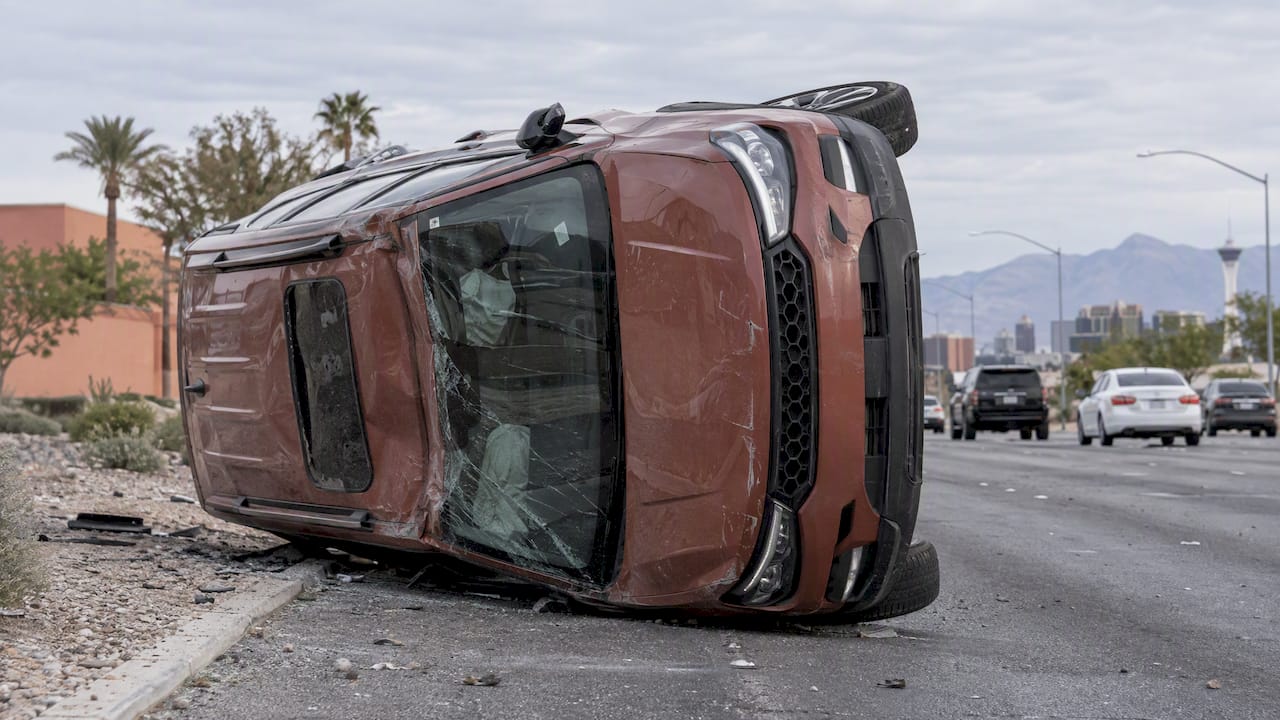
If you or someone you love was hurt or killed when a vehicle rolled over in Nevada, a rollover accident lawyer can investigate why the vehicle flipped, identify every party who may be responsible, and pursue compensation from the insurers involved. Rollovers are rarely simple. The cause may be a driver, a defective tire or roof, a dangerous roadway, or an employer who put a tired driver behind the wheel. At Summit Trial Attorneys, we represent injured people and families in Las Vegas, North Las Vegas, Henderson and across Nevada, and we never promise a particular result. We do promise a straight answer about what your case looks like.
Key Takeaways
- A rollover is a crash in which a vehicle rotates at least 90 degrees onto its side or roof, and it often points to more than one responsible party.
- Federal data show rollovers are the most harmful event in roughly 15 percent of U.S. traffic deaths, so these crashes tend to involve serious injuries.
- Evidence about the vehicle, the tires, the road and the driver can disappear fast. Preserving it early matters.
- Liability can reach drivers, manufacturers, employers and, in some cases, government entities, each with different rules and deadlines.
- A free case review costs nothing, and we are paid only if your case results in a recovery.
Table of Contents
- What counts as a rollover accident
- Why rollovers are so dangerous
- What causes rollover crashes in Nevada and elsewhere
- Who may be liable after a rollover
- What compensation may be available
- Rollover wrongful death claims
- Evidence to protect after a rollover
- Dealing with insurance companies
- How a rollover accident lawyer helps
- Perspective: why trial preparation shapes every rollover case
- Where we help in Nevada
- Talk to us about your rollover case
- Frequently asked questions
- Sources
What counts as a rollover accident
Researchers define a rollover as a vehicle rotating at least 90 degrees about its long axis, the line running from the front of the vehicle to the back. A National Academies assessment of rollover ratings separates two types. A tripped rollover happens when something physically catches the tires and trips the vehicle, such as a curb, a guardrail, a ditch or soft ground. An untripped rollover results only from sideways forces at the smooth contact between tire and pavement, for example during a hard swerve at speed.
Tripped rollovers are far more common. NHTSA data on rollover crash mechanisms indicate that about 71 percent of single-vehicle rollover crashes are tripped.
That distinction matters legally. If a vehicle was tripped by a damaged shoulder or an unmarked drop-off, the condition of the road becomes part of the story. If it rolled without being tripped, we look harder at the vehicle’s design, its tires, its load and the driver’s choices.

Why rollovers are so dangerous
The Federal Highway Administration reports that rollovers were the most harmful event in approximately 15 percent of all U.S. traffic fatalities, using 2016 to 2018 data. When a vehicle rolls, the roof can deform, occupants can strike the interior, and people who are not properly restrained can be thrown partly or fully out of the vehicle.
We commonly see clients dealing with injuries such as:
- Traumatic brain injuries and concussions
- Spinal cord and neck injuries, including paralysis
- Crush injuries and broken bones
- Internal organ damage
- Severe cuts, burns and scarring
- Psychological trauma, including anxiety and post-traumatic stress
Families who lose a loved one face a separate set of questions, which we address in the wrongful death section below.
What causes rollover crashes in Nevada and elsewhere
A peer-reviewed review of car rollover epidemiology and prevention found that human factors play a pivotal role, and that distracted driving, speeding and drinking raise the chances of a rollover. Those are driver-behavior causes. But a rollover claim often has layers beyond the driver.
Driver behavior
Speeding, distraction, impaired driving, drowsy driving and sudden overcorrection after drifting onto a shoulder can all set off a rollover. Where another driver cut someone off or forced an evasive swerve, that driver may share or bear the fault even if they never touched the vehicle that rolled.
Vehicle and tire defects
Tire tread separation, blowouts, faulty suspension parts, steering failures and weak roofs can turn an ordinary drive into a rollover. If a defect contributed, a product liability claim may be possible against the manufacturer or another company in the chain of distribution. Our Las Vegas product liability attorneys handle claims like these.
Road and roadside conditions
A steep drop-off at the edge of the pavement, missing guardrails, poorly marked construction zones, loose gravel and standing water can all trip or destabilize a vehicle. Roads in Clark County, Washoe County and rural stretches in Nye, Lyon and Elko counties differ in who maintains them, which affects who can be held responsible and how a claim must be brought.

Commercial and fleet vehicles
Tall, heavy and top-loaded vehicles are more prone to tipping. When a semi-truck, delivery van or work vehicle rolls over, the driver’s employer, a cargo loader or a maintenance contractor may be involved. Read more about how we approach these cases on our semi-truck crash page.
Rideshare, motorcycles and other vehicles
Rollovers are not limited to SUVs. Rideshare vehicles, ATVs, UTVs and some scooters can flip as well, and each category carries its own insurance and liability questions. If you were hurt as a passenger, see our pages on Uber and Lyft accidents and e-bike and scooter injuries.
Who may be liable after a rollover
More than one party can share responsibility. Depending on the facts, a claim may be directed at:
| Possible responsible party | Typical question we ask |
|---|---|
| Another driver | Did they cause the swerve, collision or loss of control? |
| The driver of the rolled vehicle | Were they speeding, impaired or distracted, and does a passenger have a claim? |
| Vehicle or tire manufacturer | Did a defect in design, manufacturing or warnings contribute? |
| Employer of a commercial driver | Was the driver on the job, overworked or poorly supervised? |
| Maintenance or repair shop | Was a tire, brake or steering component serviced negligently? |
| Government entity | Was a known roadway hazard left unrepaired or unmarked? |
Nevada follows a comparative fault system, so how much responsibility is assigned to you can affect your recovery. We explain how that works at your review. Because a single-vehicle rollover can look like the driver’s fault on a police report, we do not accept that first impression. We look at the vehicle, the road and the full chain of events.
If you want to understand how fault standards differ, our article on gross negligence versus negligence in Nevada is a good starting point.
What compensation may be available
Injured people can generally seek payment for economic and non-economic losses. In a rollover claim these may include:
- Emergency care, surgery, hospital stays, rehabilitation and future medical needs
- Lost income and reduced ability to earn in the future
- Pain, suffering and loss of enjoyment of life
- Costs of home modifications, assistive equipment or long-term care
- Property damage to the vehicle and belongings
Punitive damages are a different category. They are meant to punish especially serious misconduct, such as knowingly hiding a vehicle defect or extreme recklessness, rather than to repay a specific loss. They are not available in every case, and courts limit them. The U.S. Supreme Court held in State Farm v. Campbell that punitive awards must be reasonable and proportionate to the actual harm. You can read how this plays out in our guide to punitive versus compensatory damages in Nevada.
No lawyer can honestly tell you what a case is worth before reviewing the medical records, the evidence and the insurance coverage. Be cautious of anyone who does.
Rollover wrongful death claims
When a rollover kills someone, Nevada law allows certain family members and the estate to bring a claim. These cases are emotionally difficult, and the practical questions are urgent: who is allowed to file, what losses the family can seek, and how long they have. Because wrongful death deadlines are strict, we encourage families to speak with a lawyer early, even while they are still grieving and sorting out arrangements. Our Las Vegas wrongful death attorneys can walk you through the process at your own pace.
Evidence to protect after a rollover
Rollover cases are won or lost on evidence that is easy to lose. Vehicles get towed to salvage yards and crushed. Skid marks fade. Cameras overwrite footage. Here is what to protect, as soon as you are medically able:
- Medical care first. Get evaluated even if you feel okay. Adrenaline hides injuries, and records created right away link your injuries to the crash.
- The vehicle itself. Do not authorize repairs or salvage until a lawyer has had a chance to arrange an inspection. The roof, tires, seat belts, airbags and suspension can all hold answers.
- Event data recorder. Many vehicles record speed, braking and seat belt use in the seconds before a crash. That data can be overwritten or lost if the vehicle is destroyed or powered up and altered.
- Photos and video. Capture the scene, tire marks, roadside damage, signs, lighting and your injuries before they change.
- Witness details. Names and phone numbers of anyone who saw the crash or the moments before it.
- Police report and 911 records. Ask for the report number at the scene and request a copy once it is available.
- Nearby cameras. Businesses, traffic cameras and dashcams may keep footage only briefly. Send a written request early.
- Your own records. Keep medical bills, pay stubs, repair estimates and a short journal of symptoms and missed activities.
Independent technical assessments can also help document what happened. For example, independent vehicle damage and evidence-preservation reports show how a documented inspection of a damaged vehicle supports a claim. In a serious Nevada case, we work with qualified local experts, including accident reconstruction specialists, to examine the vehicle and the scene.
Dealing with insurance companies
Insurers often dispute what caused a crash or whether treatment was necessary. A recorded statement, a quick settlement offer or a form that asks you to sign a broad medical release can all work against you if you give them before you understand your injuries. Our advice is simple: report the crash, give your basic facts, and refer detailed questions to your lawyer.
Some insurers go further than hard bargaining. When a company fails to investigate fairly, delays payment without reason or refuses to pay a valid claim, it may be acting in bad faith. That is a separate claim from the original crash, and it matters when a policy has been ignored or a limit refused. Our team’s background includes insurance defense work, so we know how these adjusters evaluate and discount claims.
How a rollover accident lawyer helps
A lawyer does not replace your doctors or your common sense. A lawyer takes over the work that stands between you and a fair outcome while you focus on getting better. In a rollover case, that usually includes:
- Investigating the cause. Sending preservation letters, inspecting the vehicle, downloading data and visiting the scene.
- Finding every insurance policy. Driver, employer, owner, rideshare and umbrella coverage may all be relevant.
- Working with experts. Engineers, medical specialists, vocational and life-care planners help show the full scope of harm.
- Handling the insurers. Communicating with adjusters, responding to requests and rejecting lowball offers.
- Meeting the deadlines. Filing on time, including shorter notice periods that can apply to claims against government entities.
- Preparing for trial. If a company will not make a fair offer, being ready to present the case to a jury.
The deadline point deserves emphasis. Nevada sets time limits for injury and wrongful death claims, and missing them can end your right to compensation permanently. Because the length depends on the type of claim and the defendant, we confirm your exact deadline at the start rather than guess.
Perspective: why trial preparation shapes every rollover case
Insurers decide how seriously to treat a claim by asking one question: will this lawyer actually try the case? We think that is the most important question in a rollover injury claim, and we build every file as if the answer will be tested in front of a jury.
Our attorneys have seen how insurance companies evaluate and defend these cases from the inside. That perspective changes how we work. We start preserving the vehicle and its data immediately, we look beyond the driver to the tire, the roof, the road and the employer, and we speak with clients directly rather than passing them through a call center.
We cannot promise any outcome, and we will not. What we can promise is honest communication, careful preparation and a team that treats your family’s case as the most important one on its desk.
Travis
Where we help in Nevada
We represent people throughout the state, including Las Vegas, North Las Vegas, Henderson, Summerlin, Enterprise and Spring Valley in Clark County, as well as Reno and Sparks in Washoe County, Carson City, Pahrump in Nye County and Mesquite. Rollovers happen on busy urban freeways and on long rural highways where help takes a while to arrive. The stretch of road matters because it shapes who investigates, which agency holds the records and which insurers are involved. If your crash happened outside Las Vegas, tell us where, and we will explain how that affects your case.
Other firms sometimes need a Nevada trial partner for a case that crosses state lines. We also work with referring and out-of-state firms, and you can see how that works on our Nevada trial counsel page.
If your rollover involved a bus, a premises hazard such as an unsafe parking structure, or a casino or resort property, our guides on bus accidents in Las Vegas and premises liability claims in Nevada explain related liability rules.
Talk to us about your rollover case
We offer a free case review for people hurt in rollover crashes and for families who have lost someone. We will listen to what happened, explain the options and tell you honestly whether we believe we can help. We work on contingency, so there are no fees unless your case results in a recovery. Start with our free case review, or see the full range of practice areas, including car accident representation and motorcycle accident cases.

Bring whatever you have: photos, the police report number, medical paperwork and the name of your insurer. If you do not have all of that yet, call anyway. The sooner we know about the crash, the sooner we can ask for the vehicle and the data to be preserved.
Frequently asked questions
Do I need a lawyer if I was the only person in the vehicle that rolled over?
Possibly, yes. A single-vehicle rollover can still involve another party, such as a driver who forced you off the road, a manufacturer whose tire or roof failed, or a government entity responsible for a hazardous roadway. Your own policy may also provide medical or uninsured coverage you should understand. A free case review can sort out whether any claim exists.
How much does a rollover accident lawyer cost?
We handle personal injury cases on a contingency basis, which means our fees come from a settlement or judgment rather than from you up front. The details of any fee arrangement are explained and put in writing before you sign. Reviewing your case with us is free.
How long do I have to file a rollover claim in Nevada?
Nevada sets strict time limits that vary by claim type and by who the defendant is. Claims against a government entity can carry shorter notice requirements, and wrongful death claims have their own deadline. Because missing a deadline can bar your claim, contact a lawyer as soon as you can and ask for your exact date.
What if the police report blames the driver?
A police report is an important piece of evidence, but it is not the final word on fault. Officers often write reports from limited information at the scene. A thorough investigation of the vehicle, tires, road and data recorder may show additional causes, and other parties who share responsibility.
Should I talk to the other insurance company?
You should report the crash to your own insurer, but be careful with detailed statements to anyone else’s adjuster before you have spoken with a lawyer. Early comments about how you feel or what happened can be used to reduce a claim. We can handle those communications for you.
Sources
- An Assessment of the National Highway Traffic Safety Administration’s Rating System for Rollover Resistance
- Examination of Rollover Crash Mechanisms and Occupant Outcomes, NHTSA
- Epidemiology, causes and prevention of car rollover crashes
- Rollover Crashes, Federal Highway Administration
- State Farm Mutual Automobile Insurance Co. v. Campbell, Cornell Legal Information Institute
Recommended
- Las Vegas Uber & Lyft Accident Lawyers
- Las Vegas car accident attorneys
- Las Vegas Motorcycle Accident Lawyers
- Las Vegas semi-truck crash attorneys
This article was written with the assistance of AI and should never be treated as legal advice. It is not 100% guaranteed to be correct and you should never fail to contact an attorney based on its contents.
Talk with Summit
If you have questions about an injury in Nevada, our team can discuss your situation.
Request a case reviewGeneral information only; this article is not legal advice and does not create an attorney-client relationship. Past results do not guarantee future outcomes.