
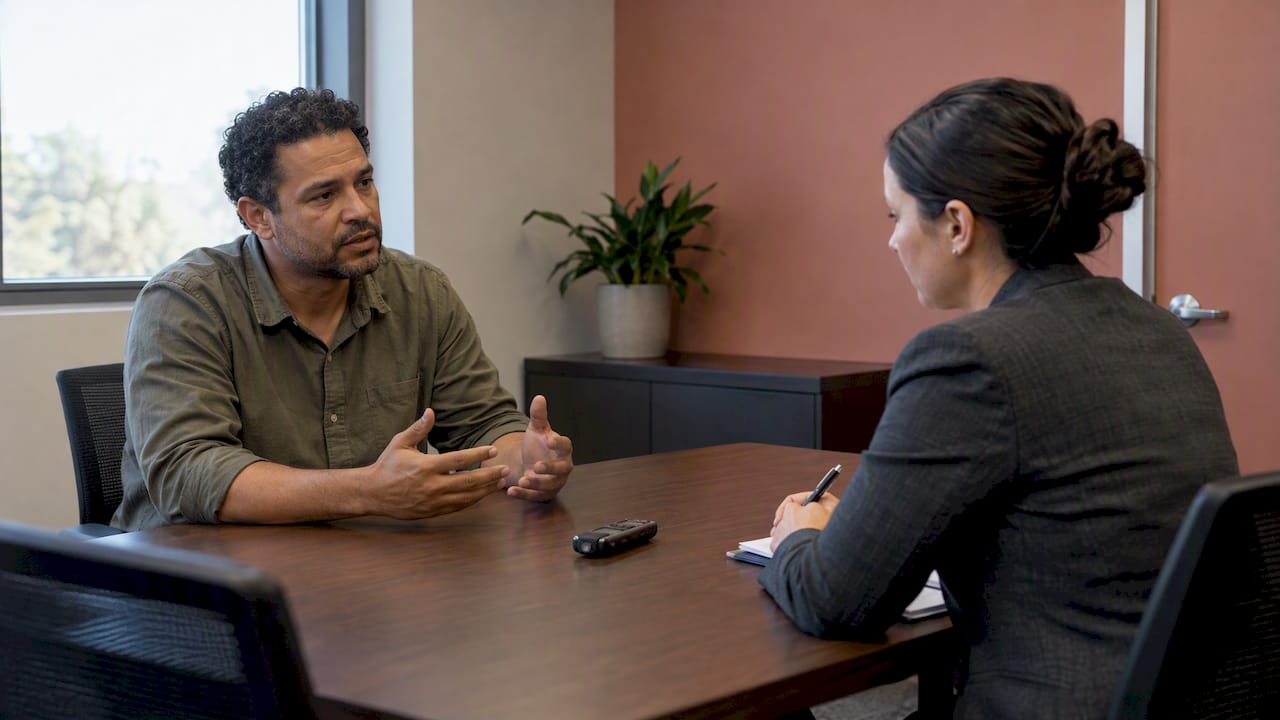
After a crash, a fall or a dog bite, an insurance adjuster will probably call you within days. The adjuster is friendly and sounds helpful, but works for the company that pays the claim. The usual tactics are a quick, low offer, a request for a recorded statement, a broad medical authorization, delay, and doubt about your injuries. You can handle each of them if you know what it looks like and what to say. This guide covers all five for injured people in Las Vegas, North Las Vegas, Henderson, Reno and the rest of Nevada.
Key takeaways
- The adjuster is not neutral. Their job is to value your claim for the insurer, and the first offer is usually a fraction of what the insurer thinks the case is worth.
- You generally do not have to give a recorded statement to the other driver’s or property owner’s insurer. You can politely decline.
- Never sign a release or a broad medical authorization until you understand how far your injuries reach.
- Keep a written record of every call, and confirm what was said by email.
- Insurers are bound by claim-handling rules, and unreasonable delay or baseless denial can cross into bad faith.
Table of Contents
- Whose side the adjuster is on
- The tactics you are most likely to meet
- How to deal with an insurance adjuster, step by step
- Negotiating with the adjuster
- When tactics become bad faith
- Our perspective
- Talk to us before you talk to the adjuster
- FAQ
- Sources
Whose side the adjuster is on
An adjuster investigates the claim, decides who was at fault, and puts a dollar figure on your losses. Each of those steps affects what the insurer pays. Adjusters are often courteous, and many are not acting dishonestly. But a polite voice does not change the structure: a smaller payout is better for the company.
That is why the tactics below show up so consistently across the pages that rank for this topic. Treat them as warning signs, not proof of misconduct. A single slow reply may be a busy desk. A pattern of delays, shifting requests and pressure to close the file is something else.

The tactics you are most likely to meet
The friendly early call
The first contact often comes before you have finished medical treatment, sometimes before you know the full extent of your injuries. The adjuster asks how you are doing. “I’m fine” or “just sore” can end up in the claim notes as evidence that you were barely hurt. Adrenaline hides pain, and some injuries, such as concussions, soft tissue damage and herniated discs, show up days or weeks later.
A safe answer is short: you are still being evaluated by your doctors and cannot say more yet.
The request for a recorded statement
Company-side guidance describes the request for an early formal statement as one of the most common moves in personal injury claims, according to USClaims’ list of claim tactics. One consumer legal guide says you do not have to give a recorded statement to the other side’s insurer and should politely decline.
The risk is simple. The adjuster has your claim file and a list of questions built for a purpose. You are answering cold, perhaps on pain medication. A guess about your speed, an offhand “I didn’t see him,” or a question such as whether you could have avoided the crash can be turned into a fault argument.
Your own insurer is different. Your policy may require you to cooperate with your own company, so read it or ask a lawyer before refusing. Even then, you can ask to review the questions first and to have an attorney present.

The broad medical authorization
Adjusters need some records to value a claim. A blanket authorization that opens years of your history is more than that. It lets the insurer search for earlier back pain, an old sports injury or a gap in treatment and argue that your current problems came from somewhere else. The same source lists prior history and downplayed delayed symptoms as standard ways to challenge causation and damages.
Offer records that relate to the injuries in this claim, and limit the time period. If the adjuster pushes back, that is a good moment to talk to a lawyer.
The fast, low offer
A quick check, sometimes within days, can feel like relief when bills are stacking up. Here is how the offer is built: it is a percentage of what the insurer thinks the claim is worth, and it tends to be low when the claimant has no representation. Signing the release closes the claim, so you cannot go back for more if surgery, therapy or lost work turns up later.
The question to ask yourself is not whether the number sounds big. It is whether you know what your injuries will cost over the next year or five.
Delay to build pressure
When a quick offer does not work, some adjusters slow down. They ask for one more form, wait weeks to return calls, or hand the file to a new person. Delay works because rent, medical bills and lost paychecks do not wait. The aim is to make a smaller number look better with time.
The model rules insurance regulators publish treat some of this conduct as an unfair practice. The National Association of Insurance Commissioners’ model act lists unreasonable delay, inadequate investigation and failure to attempt a good-faith settlement when liability is reasonably clear. It also names requiring duplicate proof or verification that unreasonably delays payment. Nevada has its own insurance code and regulator, so the exact rules and deadlines that apply to you are the Nevada ones, not the model’s.
Blaming you, or questioning the injury
Expect arguments about fault. Nevada follows a comparative negligence system, so any share of blame assigned to you can reduce what you recover. Adjusters know this, so a claim file often includes a theory that you were speeding, distracted or not paying attention. On a slip and fall at a hotel or casino, the argument may be that the hazard was obvious.
They may also challenge the injury itself. A gap in treatment, a social media post or a photo of you carrying groceries can be presented as proof you are not hurting. Adjusters sometimes hire investigators, and one consumer guide gives the example of watching a claimant with a reported back injury play soccer. Assume your public posts and physical activity can be seen.
“You don’t need a lawyer”
Some adjusters say a lawyer will only take a cut of your money or slow things down. That message appears on the same list of common tactics. Whether to hire a lawyer is your decision, but the person advising you against it works for the party that pays less when you are unrepresented.
Misstating coverage or what you can recover
Sometimes the problem is not a trick question but a wrong answer: an adjuster describes the policy limits, available damages or your rights in a way that leaves out something important. The NAIC model act treats knowingly misrepresenting relevant facts or policy provisions as an unfair claims practice. Ask for the policy language behind any statement that limits what you can claim.
How to deal with an insurance adjuster, step by step
- Get medical care first and follow it. Gaps in treatment are used against you.
- Give only the basics. Your name, contact details, the date and place of the incident, and the claim number. Do not speculate about fault or your condition.
- Decline a recorded statement from the other side’s insurer. Say you are not comfortable giving one and prefer to communicate in writing.
- Keep a communication diary. Policyholder advocates recommend documenting communications in a diary and confirming oral statements in writing. Write down the date, the name, what was said and what was promised, then follow up by email.
- Ask for the policy provision behind a position. If the adjuster denies or limits something, ask which provision, condition or exclusion applies. For first-party claims, the NAIC property and casualty model regulation says a denial based on a specific provision must identify it and be sent in writing.
- Escalate when stuck. Ask for a supervisor. If that fails, the same advocacy guide points to a complaint with your state insurance regulator. In Nevada that is the Division of Insurance.
- Do not sign a release until treatment is clear. Once signed, it generally ends the claim.
- Talk to a lawyer before any serious negotiation.
Negotiating with the adjuster
Adjusters will not make a real offer or respond to a demand until they have what they need to value the case. They typically ask for medical bills, proof of earnings, tax returns and property damage proof. Supplying that proof in an organized package helps you, and your records of each conversation help you again when numbers are disputed.
A useful negotiation file has:
- Itemized medical bills and records, including future care your doctors have recommended
- Pay stubs or a letter from your employer showing missed work and reduced earnings
- Photos of injuries, vehicle damage or the hazard where you fell
- A short written summary of how the injury changed daily life
- Your communication diary
When an offer arrives, compare it to total losses, not to the bills you have so far. Medical costs still to come, lost earning ability and pain and suffering belong in the calculation. Ask the adjuster to explain in writing how the number was reached. A refusal to explain is itself informative.
Deadlines matter as well. Regulators in several states set time limits for insurers to respond. California, for example, requires insurers to acknowledge a claim and begin investigating within 15 days and to accept or deny within 40 days after proof of claim. Those are California rules. For a claim in Clark County or Washoe County, Nevada’s own rules govern, and a Nevada attorney can tell you what applies.
When tactics become bad faith
Hard bargaining is legal. Bad faith is different. Professional guidance describes it as including inordinate delay, failure to investigate, baseless denials, or failure to explain a denial, with standards and remedies that differ by state. Where it is proven, policyholders may be able to recover damages beyond the policy amount.
Signs worth writing down:
- Your own insurer will not explain a denial or points to no policy language
- Weeks pass with no investigation of a clear claim
- The company offers far less than your documented losses and will not say why
- Your insurer ignores a reasonable chance to settle within policy limits
If this describes your situation, see our page on Nevada bad faith insurance claims.
Our perspective
Our trial lawyers have seen how insurers defend injury claims from the inside, because our approach is shaped by former insurance defense experience. That matters in a practical way. Most people lose leverage in the first two weeks, not in court: a recorded statement given too early, a release signed to cover the rent, a medical authorization that was far too wide.
We do not tell clients that every adjuster is a villain, and we never promise a result. We tell them that the call is not a favor, and that a calm, written, documented approach protects them. We also prepare every case as if it will be tried, because insurers price claims according to how credible the threat of trial is. Whether the claim comes from a crash on the Strip, a fall in a resort or a product that failed, we want you to understand what you are agreeing to before you agree.
Talk to us before you talk to the adjuster
If an adjuster is calling you, you do not need to decide anything on that call. Summit Trial Attorneys represents injured people and families across Las Vegas, North Las Vegas and the rest of Nevada on a contingency basis, so our fees come from a settlement or judgment. A free case review lets you walk through what happened, what the adjuster has asked for and what to send or hold back.

We handle car accidents, motorcycle crashes, rideshare collisions, hotel injuries, casino injuries, slip and fall cases and wrongful death claims. Every case is different, and past results do not guarantee a similar outcome.
FAQ
Should I give the insurance company a recorded statement?
You generally do not have to give one to the other party’s insurer, and you can politely decline. Offer to share basic facts in writing instead. Your own insurer may expect cooperation under your policy, so talk to an attorney before refusing it.
Should I take the first settlement offer?
Usually not before you know the full extent of your injuries. A first offer is a percentage of the insurer’s estimate of the claim’s value, and it tends to be lower when you have no lawyer. Signing a release ends your ability to ask for more.
What if the adjuster keeps delaying?
Document every request and response, ask for the reason for each new demand in writing, and escalate to a supervisor. If that does not work, you can complain to the Nevada Division of Insurance. Persistent, unexplained delay on a clear claim is something a lawyer should review.
Can an adjuster use my social media against me?
Yes, it is possible. Posts, photos and check-ins can be used to question the severity of an injury, and investigators sometimes watch claimants. Avoid posting about the incident or your activities while the claim is open, and do not delete anything without legal advice.
When does an insurer’s conduct become bad faith?
Professional guidance points to inordinate delay, failure to investigate, baseless denials or no explanation for a denial. The legal test and remedies vary by state, so a Nevada attorney should assess your facts.
Sources
- Unfair Claims Settlement Practices Act, NAIC
- Unfair Property/Casualty Claims Settlement Practices Model Regulation, NAIC
- Speak UP: How to communicate with your insurance company, United Policyholders
- Recognizing and Combating Bad Faith Claim Tactics, Anderson Kill
- So You’ve Had an Accident, What’s Next?, California Department of Insurance
- How Insurance Companies Determine Injury Settlement Amounts, Nolo via AllLaw
- 10 Insurance Tactics to Deny a Personal Injury Claim, USClaims
Recommended
- Nevada bad faith insurance attorneys
- Stacked vs. Unstacked Coverage: What Nevada Drivers Need to Know
This article was written with the assistance of AI and should never be treated as legal advice. It is not 100% guaranteed to be correct and you should never fail to contact an attorney based on its contents.
Talk with Summit
If you have questions about an injury in Nevada, our team can discuss your situation.
Request a case reviewGeneral information only; this article is not legal advice and does not create an attorney-client relationship. Past results do not guarantee future outcomes.