
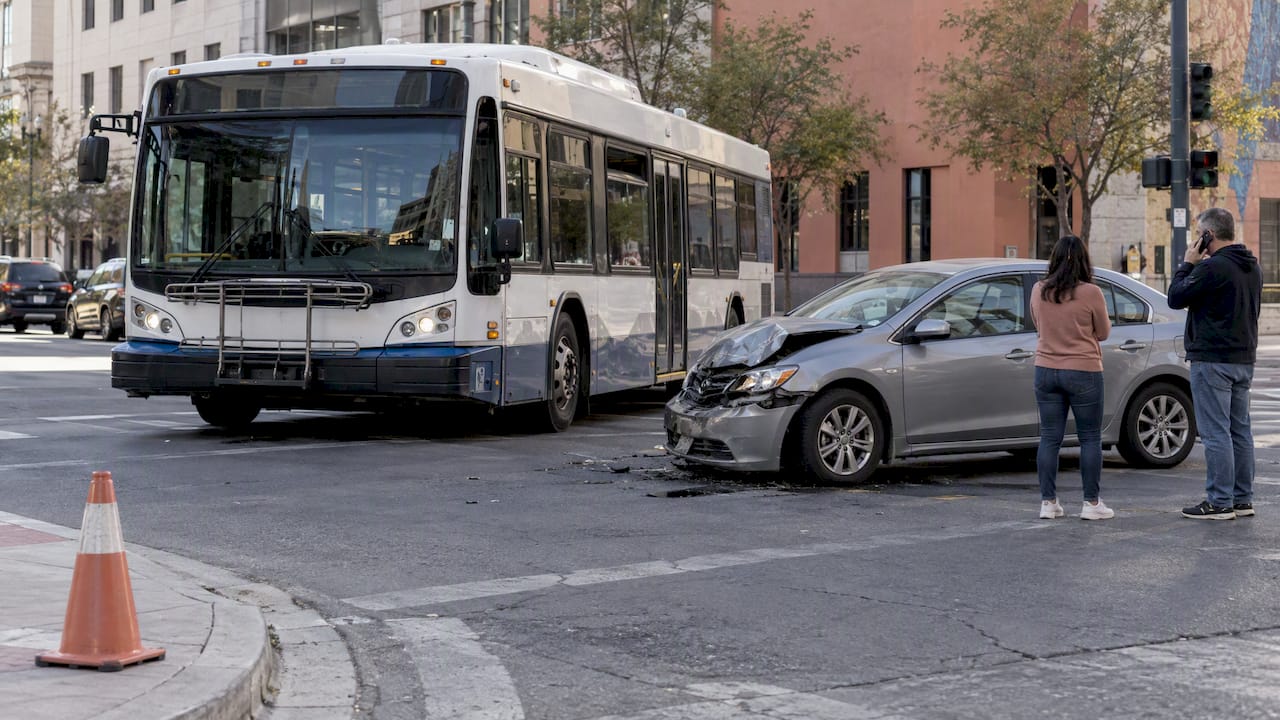
If you were hurt in a bus accident in Las Vegas, three things shape your claim more than anything else: who owned and operated the bus, what the evidence shows, and how fast you act. A city transit bus, a casino shuttle, a charter coach and a school bus can each lead to a different defendant, a different insurer and different rules. Some of those rules cut the money you can recover, so it pays to know which kind of bus hit you before anyone calls you to “just clear things up.”
This guide explains how bus claims work in the Las Vegas valley, what to do in the first days, and where the traps are. It is general information, not legal advice for your situation.
TL;DR
- Get medical care first, then preserve evidence: photos, witness names, the bus number and route, and the insurance details of every driver involved.
- The owner matters. Claims against a public transit agency like the RTC follow special Nevada rules, including a $200,000 cap on tort damages in many cases. Private tour, shuttle and charter companies are treated differently.
- Nevada’s limitation period for a death caused by another’s wrongful act is two years, and injury claims generally run on a similar clock. Do not wait.
- Video and onboard data are often lost within weeks. Ask a lawyer to send a preservation letter early.
- Do not give a recorded statement to any insurer before you understand your rights.
Table of Contents
- Why bus crashes are not ordinary car crashes
- The kinds of buses involved in Las Vegas crashes
- What to do in the first 72 hours
- Who can be held responsible
- Claims against the RTC, a school district or another public entity
- Evidence that decides bus cases
- What compensation can cover
- Common mistakes after a bus accident
- Our perspective
- How we can help
- FAQ
- Sources
Why bus crashes are not ordinary car crashes
In a two-car collision, you usually have two drivers and two insurers. A bus crash adds layers. There is the driver, the company that employs the driver, the company that owns or maintains the vehicle, sometimes a contractor that runs the route, and sometimes a manufacturer. Each has its own insurer and its own lawyers, and each may point at the others.

Buses also carry many people at once. When a crash hurts a dozen passengers, claims compete for the same insurance policy, and early, careful action can matter. On July 31, 2026, a sedan and a packed RTC transit bus collided at 13th and Fremont streets downtown. At least 14 people were taken to hospitals with injuries reported as non-life-threatening, and firefighters had to cut the roof off the car to reach a trapped occupant. Injuries that look minor on day one can still turn into months of treatment. A neck or back injury, a concussion or a torn shoulder often shows its full cost later.
The kinds of buses involved in Las Vegas crashes
Las Vegas has an unusual mix of buses, and the type decides who you pursue.
Public transit buses
RTC buses run the Strip, downtown and the neighborhoods in between. Crashes happen in two ways: the bus driver causes the collision, or another driver, such as one running a red light, hits the bus. In May 2026, police believed a Honda SUV ran a red light on Charleston and hit an RTC bus. If you were a passenger, the at-fault party might be the other driver, the transit operator, or both. If you were in the other vehicle, the facts about the bus driver’s speed, attention and training come into play.
Tour buses and charter coaches
Tour operators run daily trips from Las Vegas to the Grand Canyon, Hoover Dam and beyond, and many crashes happen outside Nevada. A January 2021 rollover in northwestern Arizona involved a Las Vegas-based tour bus whose driver also acted as the guide. Investigators from the Mohave County Sheriff’s Office looked at speed, mechanical compliance and the driver’s dual role. A driver doing two jobs is a safety question a lawyer will ask about in any tour-bus case.
In one 2019 incident near Aria, a tour bus backed into a pillar and nine people went to the hospital as a precaution. Low-speed crashes still hurt people, especially older passengers and anyone standing.
A crash outside Nevada raises extra questions about where a suit can be filed and which state’s law applies. Tell any lawyer early if your trip crossed a state line.
Casino and hotel shuttles
Resort shuttles and airport transfers add another possible defendant: the property that offers or contracts for the service. If you were hurt on a shuttle or while boarding at a resort, our hotel injury practice handles claims where the property’s responsibility is part of the story.
School buses and private fleet buses
School bus crashes make local news often, including a December 2025 two-vehicle crash in the east valley. These involve the school district, which is a government entity, so the public-entity rules below apply. Church, nonprofit and employer buses are usually private, though a charity’s insurance may be thinner than a commercial carrier’s.
What to do in the first 72 hours
- Get medical care. Call 911 if you can, and accept the ambulance or go to the ER the same day. Adrenaline hides pain. A gap between the crash and your first treatment is something insurers use against you.
- Report the crash. Make sure Las Vegas Metropolitan Police or the Nevada Highway Patrol responds and a report is written. Ask for the report number.
- Record what you can. Photograph the bus (including the number on the side and the license plate), the road, signals, skid marks and your injuries. Get names and phone numbers of passengers and witnesses. Eyewitness memory fades quickly and can conflict.
- Identify the carrier. Ask for the company name on the bus, the driver’s name and the insurance information. If you cannot get it, say so in the police report.
- Notify your own insurer. Standard auto policies require prompt notice. A Nevada Division of Insurance sample policy lists reporting the accident and cooperating with the insurer among your duties after a loss, and failing at them can put coverage at risk. Report the facts, keep it short and do not guess about fault.
- Skip the other side’s recorded statement. The bus company’s adjuster is not working for you. Politely decline until you have advice.
- Keep a simple journal. Note pain levels, missed work, appointments and things you can no longer do. It helps later.
If you were on a rideshare or in a car struck by a bus, our pages on Uber and Lyft accidents and car accidents cover the overlapping issues.
Who can be held responsible
Liability in a bus case turns on proof, not on who looks more sympathetic. Possible defendants include:
| Defendant | When it applies | What we would look at |
|---|---|---|
| Bus driver | Speeding, distraction, fatigue, unsafe lane changes, running lights | Driving record, phone records, hours worked |
| Bus operator or employer | Poor hiring, training or scheduling; the employer is usually responsible for an employee’s driving on the job | Training files, safety policies, driver logs |
| Owner or maintenance contractor | Worn brakes, tires or steering | Inspection and repair records |
| Other driver | The bus was hit by someone else | Police report, video, witnesses |
| Manufacturer | A defect in the bus or a component | Design and recall history |
| Property owner or road authority | Unsafe loading area, bus stop or roadway | Design plans, prior complaints |
Product cases are demanding. Legal commentary on Nevada transportation law notes that claims against a manufacturer often depend on proving that the vehicle was defective or unreasonably dangerous, and that in serious cases juries have awarded large sums for a family’s grief and loss of companionship. Our product liability practice handles claims of this kind.
Pedestrians, cyclists and motorcyclists
People outside the bus are often the most badly hurt. A pedestrian struck in a crosswalk, a cyclist in a bus lane or a rider on a scooter has no steel around them. Bus stops are also a recurring concern: after a crash at a stop left two people dead and three injured, local reporting recorded people questioning bus stop safety. If this was you, see our pages on pedestrian accidents, motorcycle accidents and e-bike and scooter injuries.
Claims against the RTC, a school district or another public entity
When the bus belongs to a government body, Nevada’s tort claims rules apply, and they differ from a claim against a private company in ways that matter.
A damages cap. NRS 41.035 limits an award in a tort action against a political subdivision, or its officers and employees acting within their duties, to $200,000, exclusive of interest, with its own exceptions. That cap is a major reason to find out early whether other parties share fault. A second driver, a maintenance contractor or a manufacturer is not necessarily protected by it.
Notice and deadlines. The Nevada Tort Claims Act includes a process for filing a claim with the governing body of a political subdivision under NRS 41.036. Whether you file one before suing, and how, is a technical point where mistakes are costly. Do not treat it as optional paperwork. Have an attorney handle the notice quickly, ideally within weeks, not at the end of your limitation period.
The clock. The general limitation period for personal injury in Nevada is two years from the injury. For a death caused by another’s wrongful act, Nevada also allows two years from the underlying accident or injury, which matters when someone survives for a time before passing away. Two years sounds long. In practice, evidence is gone in a fraction of that time.
If you lost a family member in a bus crash, our wrongful death practice can explain who may bring the claim and what damages the law recognizes.

Evidence that decides bus cases
Bus cases are won or lost on records that only the other side controls, and that get overwritten on a schedule.
- Onboard video. Many transit and tour buses carry interior and exterior cameras. Footage is often the best proof of what happened, and it can override what witnesses remember in the stress of a crash. This is one reason investigations of transit crashes can rely on camera and sensor data, as the NTSB’s report on a 2017 Las Vegas shuttle collision shows in a technology-heavy setting.
- Driver records. Hours of service, logs, training, drug and alcohol testing, prior incidents.
- Vehicle data. Speed, braking and event recorders, plus maintenance history.
- Dispatch and GPS records. They show route, schedule pressure and location.
- Phone records. Distraction is a common factor in crashes of every kind.
- Scene evidence. Signal timing, lighting, road design and bus stop layout.
A preservation letter puts the carrier on written notice that it must keep this material. If it is destroyed after the letter, courts can treat that seriously. That is why we encourage injured people to call before the footage is overwritten, not after.
Who investigates also varies. Most bus crashes are handled by local police, while the NTSB generally steps in for highly automated vehicles even when injuries are minor. A police report is useful, but it is not the full investigation your case needs. For self-driving shuttles and similar technology, see our post on self-driving car accidents in Las Vegas.
What compensation can cover
A bus injury claim can include several categories of loss:
- Past and future medical bills, including surgery, therapy and medication
- Lost income, and lost earning capacity if you cannot return to the same work
- Pain, suffering and loss of enjoyment of life
- Property damage
- In a death case, funeral costs and the family’s loss of support, companionship and grief
No lawyer can honestly promise a number. Value depends on injuries, fault, available insurance and, for public entities, the cap above. Be wary of anyone who quotes a figure before reviewing your records.
Common mistakes after a bus accident
- Settling fast. Early offers are made before your doctors know your long-term outlook. Once you sign a release, it is final.
- Posting online. Photos of a weekend outing can be used to argue your injuries are minor.
- Missing treatment. Gaps give the insurer an argument that you were not really hurt.
- Admitting fault. An apology at the scene or a casual “I didn’t see the bus” can be quoted later.
- Assuming the bus company is the only target. Shared fault is common, and the cap on public entities makes it more important to find every responsible party.
- Waiting for the police report to settle everything. Reports contain mistakes and opinions. They are a starting point.
Our perspective
Our lawyers come to injury work with a background in how insurers defend claims, and that shapes how we see bus cases. A carrier’s first moves are predictable: get a recorded statement, frame the injury as minor, point at another driver, and wait while evidence ages. Knowing that playbook lets us counter it from the first week. We ask for the video, the driver file and the maintenance history early, and we prepare each case as if it will be tried, because a carrier prices a claim differently when it believes the other side will go to a jury.
We also speak with clients directly. You should know where your case stands and why we are making each decision. Bus cases are rarely simple, and a clear explanation of the public-entity rules, the competing defendants and the realistic timeline is worth more than a confident promise.
How we can help
Summit Trial Attorneys represents people injured in Las Vegas and North Las Vegas, including in transit, tour, shuttle and other vehicle crashes, as well as families facing a wrongful death. Our cases are handled on a contingency basis, so our fees come from a settlement or judgment. We start with a case review: we look at the crash, the vehicles and companies involved, and the deadlines that apply to you. If something else should happen first, such as preserving footage, we tell you.
To talk through your situation, request a free case review. You can also browse our full list of practice areas.
FAQ
Who is liable in a Las Vegas bus accident?
It depends on the facts. The driver and the company that employs the driver are the usual starting points, but another motorist, a maintenance contractor, a manufacturer or a property owner can also share fault. If the bus belongs to a public agency, special Nevada rules and a damages cap apply to claims against that agency.
How long do I have to file a claim?
Nevada’s limitation period for a wrongful death is two years from the underlying accident or injury, and injury claims generally follow a similar two-year window. Claims against government bodies may involve extra notice steps, so speak with an attorney well before the deadline.
What if I was hurt on a tour bus that left Las Vegas?
A crash in another state, like the Arizona rollover of a Las Vegas-based tour bus, can change where a case is filed and which law applies. Keep your ticket or booking confirmation, note the company’s name and get medical care wherever you are. Then talk to a lawyer before you accept any travel-company payment or voucher.
Should I talk to the bus company’s insurance adjuster?
You can confirm basic facts, but do not give a recorded statement or sign a release before getting advice. Adjusters work for the insurer. Your own policy also requires you to report the crash and cooperate, as the Nevada Division of Insurance sample policy describes, so report it to your own insurer promptly and stick to facts.
What if the crash was minor and I feel fine?
Get checked anyway. Soft-tissue and head injuries often show up days later. A prompt medical record protects your health and supports your claim if symptoms develop.
Sources
- At least 14 suffer injuries after crash involving transit bus in downtown Las Vegas, Las Vegas Review-Journal
- RTC transit bus crash near Fremont Street injures 14 people, FOX5 Vegas
- Bus in deadly Grand Canyon crash offers tours by comedians, AP News
- Tour bus backs into pillar near Aria, News3LV
- NRS 41.035, Limitation on award for damages in tort actions, Justia
- Nevada Wrongful Death Laws, Recording Law
- Nevada Division of Insurance sample auto policy
- Nevada transportation law, ALFA International
- NTSB Highway Accident Brief HAB-19-06
- Self-driving vehicle operators learn from 2017 Las Vegas crash, Las Vegas Review-Journal
Recommended
- Las Vegas car accident attorneys
- Las Vegas Uber & Lyft Accident Lawyers
- Las Vegas Pedestrian Accident Lawyers
Written with BabyLoveGrowth to rank higher on Google
This article was written with the assistance of AI and should never be treated as legal advice. It is not 100% guaranteed to be correct and you should never fail to contact an attorney based on its contents.
Talk with Summit
If you have questions about an injury in Nevada, our team can discuss your situation.
Request a case reviewGeneral information only; this article is not legal advice and does not create an attorney-client relationship. Past results do not guarantee future outcomes.